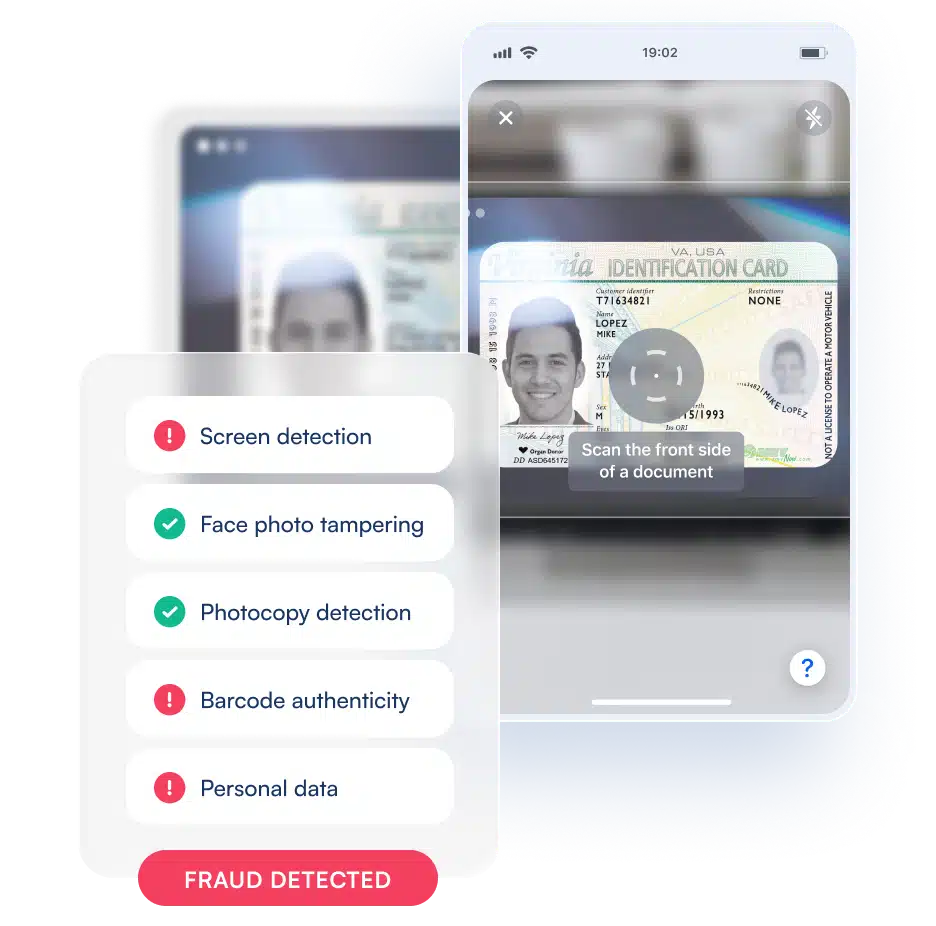

What Is Document Verification and How Does it Work

Identity document verification ensures the authenticity of presented documents, which helps to mitigate the risk of fraudulent activities and breaches in the finance sector. It’s actually a pretty important system, especially in regulated and monitored industries like healthcare and banking, where regulations are extremely strict.
By using document verification software, businesses can reduce the risk of fraud and ensure they comply with all the necessary rules and regulations. But it’s not just about following the rules—ID document verification also helps build trust between companies and their customers.
As processes increasingly shift online, the need for a strong identity verification system has become even more crucial. This is evident due to the significant surge in users for online banking, cloud computing, and other virtual procedures.
We’ve put together a comprehensive guide to identity document verification, including what it is, how it works, the pros and cons, and even an example of how it’s used in the finance industry.
What is Documentation Verification?
Document verification is the process of confirming the authenticity and integrity of identity documents, such as passports, driver’s licenses, and national ID cards. It’s commonly used in Know Your Customer (KYC) and Anti-Money Laundering (AML) workflows to verify that a person is who they claim to be.
In regulated industries like financial services, gaming, and e-commerce, identity document verification plays a critical role in preventing fraud, meeting regulatory requirements, and ensuring a seamless customer experience.
The Document Verification Process: Step-by-Step
Modern digital document verification typically follows this workflow:
- Image Capture
The user uploads or scans an identity document using a mobile device or webcam. - Preprocessing
The system enhances image quality, detects glare or blur, and ensures the document is readable. - OCR and Data Extraction
Optical Character Recognition (OCR) extracts structured data (name, date of birth, document number, etc.) from the ID. - Document Classification
The system identifies the document type (e.g., passport vs. driver’s license) and country of origin. - Security Feature Checks
Algorithms analyze document layout, font, and embedded features to detect tampering or forgery attempts. - Cross-Validation
Extracted data is validated against known document templates and third-party databases, if applicable. - Risk Scoring & Decisioning
The document is scored for authenticity, and either approved automatically, flagged for review, or rejected.
This end-to-end process can take under 3 seconds with the right tools — and avoids the friction of manual review or back-and-forth emails.
Manual vs. Digital Document Verification
| Feature | Manual Verification | Digital Document Verification |
|---|---|---|
| Speed | Minutes to days | Under 5 seconds |
| Accuracy | Human error-prone | >95% accuracy with AI/ML |
| Scalability | Labor-intensive | Fully automated |
| Fraud Detection | Limited | Tampering, spoofing, and synthetic ID detection |
| Cost | High (labor, delays) | Lower per-check cost, especially at scale |
Digital solutions offer a clear advantage in terms of speed, fraud prevention, and regulatory consistency — especially for high-volume industries like fintech and crypto.

KYC and AML Compliance Use Cases
KYC document verification is foundational for:
- Banks and fintechs onboarding new accounts
- Cryptocurrency exchanges meeting FATF Travel Rule requirements
- Buy now, pay later (BNPL) providers vetting borrowers
- Gaming platforms verifying user age and identity
- Gig economy apps authenticating delivery drivers or freelancers
With AML and KYC enforcement ramping up globally, real-time document verification helps avoid fines, chargebacks, and reputational risk — all while improving onboarding conversion.
Technology That Powers Digital Document Verification
Modern solutions go beyond simple data extraction. Here’s what separates the leaders from legacy systems:
- AI-powered OCR
Accurate data extraction from global ID types, even with poor lighting or partial obstructions. - Machine Learning Fraud Detection
Identifies forged documents, tampered photos, mismatched fonts, and altered security features. - Liveness Detection & Face Matching
Adds biometric matching between the ID and a selfie to prevent impersonation and spoofing. - Device-Side Processing
Keeps sensitive data off the cloud and ensures GDPR/CCPA compliance with edge-based verification.
Microblink’s proprietary models are trained on millions of document images from 150+ countries, ensuring high coverage and performance for identity verification at scale.

Key Business Benefits of Document Verification
- Faster Onboarding
Cut customer drop-off with 3-second verification flows. - Fraud Prevention
Detect forged, stolen, or synthetic IDs before they enter your system. - Operational Efficiency
Eliminate manual review queues and reduce compliance overhead. - Global Scalability
Support ID documents from over 150+ countries in real time. - Audit Readiness
Maintain structured logs and audit trails for every verification decision.

Costs and Pricing Models
Document verification pricing varies by provider, but the most common models are:
- Per-transaction pricing
Pay per verification (common for startups or usage-based billing). - Tiered subscription plans
Volume-based packages with committed monthly usage. - Custom enterprise pricing
Bundled rates that factor in document volume, regions supported, and SLA requirements.
Compared to manual verification, digital solutions offer substantial ROI through reduced labor costs, faster customer conversion, and fraud-related loss prevention.
Integration Considerations and Technical Requirements
Before integrating a digital document verification API, evaluate:
- Implementation timeline (most SDKs can be deployed in under a week)
- Device compatibility (iOS, Android, web support)
- Ease of integration (RESTful APIs, prebuilt SDKs, documentation quality)
- Data privacy and storage (GDPR-compliant processing, on-device vs. cloud)
Microblink, for example, offers flexible SDKs with support for edge-based document capture and customizable workflows — no need to reinvent the wheel.
Performance Metrics That Matter
When evaluating document verification solutions, look for:
- Processing speed (<3 seconds per document)
- Accuracy rates (95–99%+ OCR precision)
- False positive/negative rates (especially important for fraud detection)
- Coverage (supported ID types and regions)
- Uptime and SLA performance (crucial for real-time onboarding)
Microblink’s engine is benchmarked continuously using real-world datasets and synthetic ID scenarios to ensure consistent performance.
Ready to Modernize Your Document Verification Process?
Let’s talk about how we can help your team reduce fraud, speed up onboarding, and meet regulatory requirements — without adding friction to your workflows.
Contact us to learn more.