
New Account Fraud: Understanding the Warning Signs

In recent years, new account fraud has quietly evolved from a nuisance into a board-level risk. High-profile cases — including multi-year investigations tied to fake accounts, identity manipulation, and large-scale onboarding abuse — show just how quickly small gaps in verification can spiral into serious financial, regulatory, and reputational damage.
For fraud prevention leaders, the challenge is twofold: detecting increasingly sophisticated new account fraud red flags while still delivering a frictionless onboarding experience for legitimate customers. Below, we break down the warning signs, why they matter, and how risk teams can get ahead of emerging attack patterns.
What Is New Account Fraud?
New account fraud occurs when bad actors open accounts using stolen, synthetic, or manipulated identity information, or when they hijack dormant accounts without detection. Once an account is established, fraudsters move quickly, executing transactions, exploiting promotional offers, laundering funds, or setting up future credit abuse.
Today, these attacks are increasingly powered by bots, AI-driven identity fabrication, and automated credential harvesting, making them harder to spot with legacy controls.
The New Account Fraud Red Flags That Matter Most
Risk teams must be vigilant during onboarding and the early life cycle of accounts. Key red flags include:
1. Identity inconsistencies
- Mismatched or low-quality identity documents
- Recently issued IDs with no supporting history
- Incomplete or oddly formatted personal information
- Address or phone numbers linked to multiple recent applications
These issues often indicate synthetic identity creation or manipulated documents.
2. Unusual onboarding behaviors
- High-velocity application attempts
- Attempts using the same device, IP, or behavioral pattern across multiple identities
- Avoidance of verification steps (e.g., abandoning when prompted to upload an ID)
These patterns frequently signal bot-driven or AI-assisted enrollment.
3. Suspicious early account activity
- Immediate high-value transactions
- Rapid profile edits (phone number, email, address)
- Logins from geographies inconsistent with stated residence
- Sudden transfer behavior atypical for a brand-new customer
Post-onboarding anomalies often indicate mule accounts or account takeover attempts.
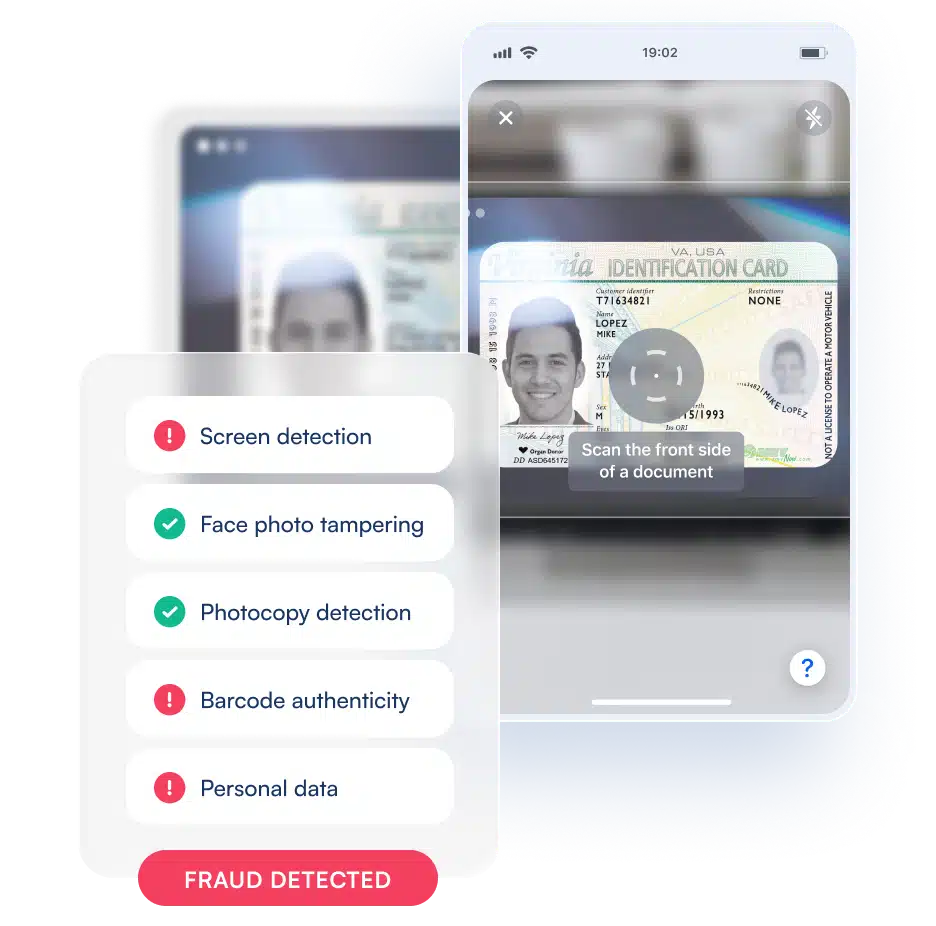
4. Document tampering signals
With deepfake IDs proliferating, red flags now include:
AI-generated portraits that fail liveness testing
Missing microprint or holograms
Artifacts from cut-and-paste or digital manipulation
Face mismatch between selfie and document
Why These Red Flags Matter
Failure to detect early indicators of new account fraud creates cascading risk:
- Financial losses from unauthorized transfers, promo abuse, or synthetic credit lines
- Regulatory exposure, especially under evolving KYC/AML expectations
- Audit gaps when account creation processes aren’t defensible
- Reputational damage and customer trust erosion after public fraud incidents
Industry data reinforces the trend: digital onboarding attacks continue to rise, and fraudsters are rapidly shifting toward techniques that exploit automation and weak identity verification controls.ud works by manipulating lax account monitoring systems; awareness and vigilance form the best defense against these attacks.
How Risk Teams Can Address New Account Fraud Red Flags
A modern fraud strategy blends technology, process, and people. Key actions include:
1. Use AI-powered identity verification
Fraudsters increasingly use automation—so banks and fintechs must as well.
AI/ML-driven systems can detect hidden document manipulation, evaluate biometric matches, and flag behavioral anomalies that manual review often misses.
2. Strengthen continuous monitoring
Onboarding is just the start. Early-life account monitoring should include:
- Transaction anomaly detection
- Behavioral analytics
- Device intelligence
- Geolocation mismatch alerts
3. Enforce regular audits and controls
Regular reviews uncover gaps in:
- Document verification steps
- Risk scoring thresholds
- Reviewer workflows
- Data retention and compliance protocols
4. Train employees and customers
Well-structured education programs help team members recognize:
- Synthetic ID signals
- Suspicious application sequences
- Document forgery patterns
- Social engineering tactics
Customer education also reduces downstream account takeover risk.
How Microblink helps mitigate new account fraud risks
Microblink equips banks, fintechs, and financial institutions with the tools needed to catch fraud at the moment of account creation without adding unnecessary friction to legitimate users.
Our automated identity verification platform helps teams:
- Detect more fraud with greater accuracy, reducing false positives
- Spot synthetic identities using document intelligence, biometric checks, and fraud signal analysis
- Identify deepfake and manipulated IDs with advanced AI models
- Streamline onboarding through fast, reliable document capture and verification
- Maintain audit readiness with transparent, reviewable verification evidence
By pairing document verification, biometric validation, and AI-driven fraud analytics, Microblink helps organizations stay ahead of evolving new account fraud threats.
To learn more, contact us today!