
The Keys to New Account Fraud Prevention

Opening a new account should be a moment of opportunity for both customer and business. But for fraud prevention professionals, it’s also a moment of maximum risk.
Unlike established accounts, new account openings provide fraudsters a clean slate to exploit. There’s no transaction history to analyze, no behavioral baselines to compare, and very little data to triangulate against known fraud signals. This makes new account fraud prevention one of the most difficult and urgent challenges facing risk teams today. In fact, new account fraud makes up a whopping 90% of all credit card fraud, according to research from The Motley Fool.
Whether it’s synthetic identity fraud, stolen credentials, or account farming bots, attackers are evolving quickly. Risk leaders must adapt just as quickly, leveraging smarter tools and more agile strategies to protect their institutions without creating barriers that drive legitimate customers away.
Why New Account Fraud Is So Hard to Detect
New account fraud thrives in the absence of context. Traditional fraud detection tools rely heavily on transaction monitoring, customer behavior analysis, or account history—all things that simply don’t exist at the point of account creation.
This blind spot allows bad actors to:
- Create synthetic identities using a mix of real and fake information
- Exploit welcome bonuses and referral programs through account farming
- Open accounts with stolen PII and disappear before detection catches up
- Prepare for bust-out schemes, where multiple fake accounts sit dormant before draining funds
It’s no surprise that new account origination fraud prevention has become a top priority.
Key Strategies for New Account Fraud Prevention
To stay ahead of fraudsters while still enabling fast, seamless onboarding, businesses need to embrace modern fraud-fighting techniques. Here are the pillars of an effective new account fraud prevention strategy:
1. Detecting Synthetic Identity Fraud
Synthetic identity fraud is now the fastest-growing form of financial fraud. These accounts often pass superficial checks because they’re built to look “real” and often combine legitimate Social Security Numbers (frequently of minors or deceased individuals) with fake names, emails, and phone numbers.
To catch them, you need fraud detection tools that can cross-reference data against government-issued IDs as well as verify liveness through biometric checks.
Furthermore, it is vital to have the ability to analyze inconsistencies in data submissions (e.g., mismatched ZIP codes and IP geolocation) and use identity graphing and device intelligence to spot networked fraud rings.
2. Identity Verification Without Transaction History
When onboarding a brand-new customer, risk teams can’t depend on behavioral biometrics or account-level anomaly detection. Instead, the solution lies in robust, front-end identity proofing.
Best practices include:
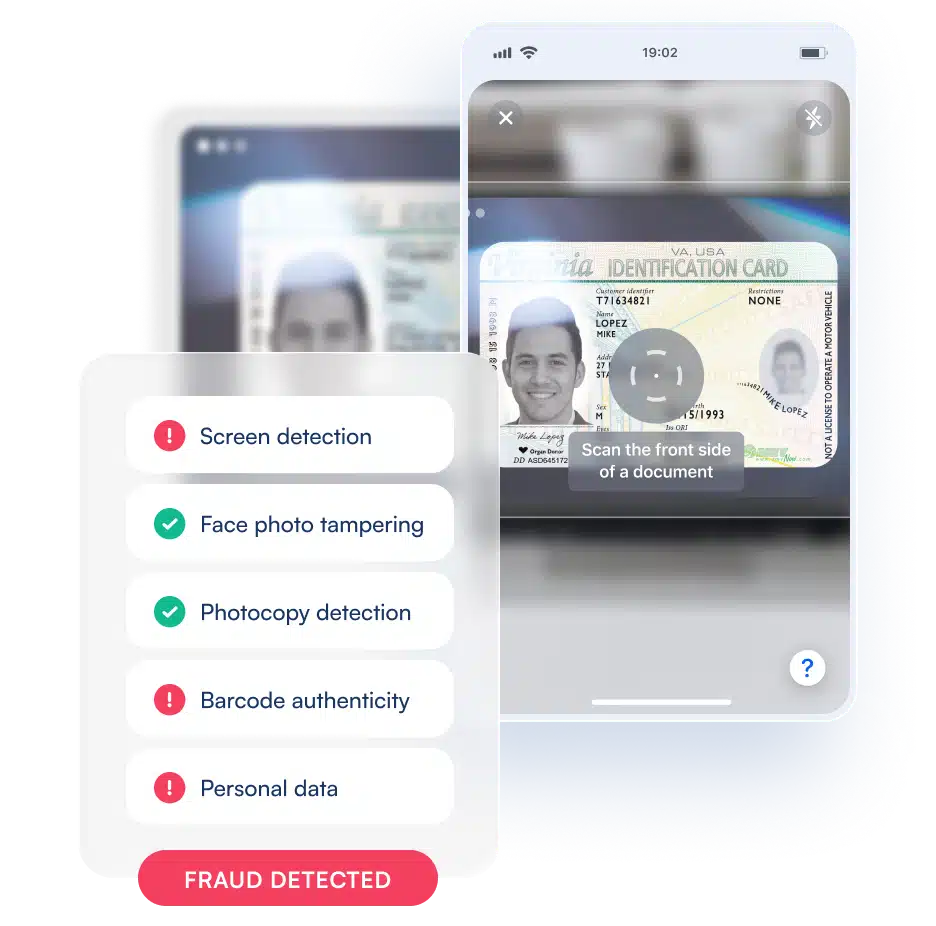
- Scanning and validating government-issued IDs in real time
- Using facial recognition and liveness detection to confirm the applicant is real and present
- Comparing application data to third-party databases and fraud consortiums
- Running passive signals like device fingerprinting and IP risk scoring in the background
With no prior history to lean on, it’s crucial to build trust from the very first data point. This is especially true for new account fraud prevention in banking, where even a single missed signal can result in downstream fraud, compliance violations, or financial loss. Identity verification must be airtight from the outset, which includes validating documents, confirming liveness, and checking for synthetic patterns before the account is ever created. The more robust your front-end screening, the less risk you carry post-origination.
3. Real-Time Risk Scoring for New Applications
New account fraud prevention tools must be able to score risk instantly—before an account is created. Real-time risk engines analyze dozens of data signals.
| Signal Type | What It Detects |
| Document Authenticity | Forged IDs, manipulated files |
| Device Intelligence | Emulators, spoofed devices, reused devices |
| IP & Geolocation | Suspicious IPs, proxy use, geolocation mismatch |
| Biometric Matching | Deepfake attempts, liveness spoofing |
| Data Consistency | Mismatched names, DOBs, phone/email combos |
The more signals analyzed, the better the fraud detection, especially when machine learning models are tuned for new account origination risk.
4. Balancing Security with User Experience
One of the biggest challenges in new account fraud prevention is maintaining a high level of security without disrupting the customer experience. Overly rigid verification processes can cause legitimate users to abandon the application, while lax controls invite fraud. The solution lies in a risk-based authentication approach, where friction is applied dynamically based on the level of perceived risk.
For example, low-risk users can enjoy a near-instant, frictionless onboarding process, while medium-risk applicants might be prompted to upload a photo ID or complete a selfie check. High-risk signals — like mismatched identity data, suspicious IPs, or reused devices — can trigger manual review or an outright rejection. By tailoring the onboarding experience to the risk level of each application, financial institutions can preserve both conversion rates and fraud prevention outcomes.
5. Blocking Account Farming and Bust-Out Fraud
Fraudsters often use automated tools or low-cost labor to open hundreds of fake accounts, a tactic known as account farming. These accounts may be used to exploit sign-up bonuses, facilitate money laundering, or stage bust-out schemes where fraudsters build fake creditworthiness over time before vanishing with large withdrawals. To combat this, businesses need preventative measures that flag mass account creation and coordinated attacks early.
This includes identifying shared device fingerprints, analyzing IP addresses for suspicious patterns, and running velocity checks to detect high volumes of new accounts or login attempts from a single source. Tools that incorporate bot detection, CAPTCHA, and device intelligence can identify and block account farming efforts before they gain traction, thus ensuring only legitimate users are onboarded.
6. Reducing False Positives and Operational Friction
False positives remain a major issue in fraud prevention, especially during new account onboarding, where there’s little prior data to confirm or deny user legitimacy. Overly sensitive systems can flag real customers as fraudulent, forcing manual reviews and increasing operational costs. Worse yet, false positives can result in customer frustration, drop-offs, or reputational damage. That’s why it’s essential to use fraud detection tools with high accuracy rates, customizable decision thresholds, and the ability to contextualize risk rather than rely on binary triggers. Platforms like Microblink incorporate advanced document analysis, liveness detection, and cross-referenced data to make informed decisions that minimize unnecessary friction.
Moreover, smart workflows can route questionable cases to human reviewers without creating bottlenecks. Automated escalation paths, combined with real-time feedback loops and detailed audit logs, allow risk teams to stay efficient while ensuring every decision can be justified under regulatory scrutiny. The best systems also support continuous learning and improve over time based on reviewer input and fraud outcomes. This blend of automation, precision, and flexibility is key to stopping new account fraud without sacrificing speed, scalability, or customer trust.
The Microblink Advantage
For risk managers who need to prevent fraud without blocking legitimate customers, Microblink offers a modern solution with features such as:
- AI-powered ID and biometric verification
- Real-time risk scoring based on passive and active signals
- Fraud detection built for new account origination
- Fast processing and high verification success rates
- Seamless API integration into existing workflows
By enabling fast, accurate identity decisions, Microblink helps financial institutions strike the perfect balance between security, compliance, and customer experience.
New account fraud prevention isn’t just about detecting bad actors, it’s about doing so in real time, without dragging down legitimate users. In a digital world where first impressions matter, financial institutions must protect themselves without putting the brakes on growth.
With tools like Microblink, risk teams can finally have it both ways: fraud protection that’s fast, frictionless, and built for the realities of modern account origination. If you’d like to learn more, get in touch today!