
Best KYA Software for Agentic Fraud Prevention (2025)
The era of « agentic commerce » is no longer a futuristic concept—it’s our current reality. As AI agents begin to autonomously negotiate contracts, execute payments, and manage supply chains on behalf of humans, a new vulnerability has emerged: Agentic Fraud.
When an AI acts as your proxy, how does a merchant know that the agent is authorized, the code is untampered with, and the underlying intent is legitimate? Traditional KYC is no longer enough. To secure the future of autonomous transactions, organizations are pivoting toward Know Your Agent (KYA) frameworks.
KYA is the process of verifying the identity, origin, and integrity of non-human actors. Without robust KYA software, businesses risk falling victim to sophisticated synthetic fraud, unauthorized agentic « raiding, » and complex account takeovers that move at machine speed.
In this guide, we analyze the top KYA and AI-driven fraud prevention platforms that provide the identity verification, behavioral analysis, and risk orchestration required to maintain digital trust in an automated world.
How We Chose These Tools
To curate this list, we evaluated dozens of identity and fraud prevention platforms based on their ability to handle the specific demands of agentic commerce. Our selection criteria focused on:
- KYA Specialization: Does the tool offer specific frameworks for verifying AI agents or the developers behind them?
- Latency & Speed: Can the software process verifications in real-time to match the velocity of autonomous agents?
- Advanced ML Capabilities: Does the platform use unsupervised machine learning to detect novel, « never-before-seen » agentic attack vectors?
- Orchestration: Can the tool integrate multiple data signals to provide a holistic risk score?
What to Look for in KYA Software
When selecting a KYA solution for your organization, prioritize these three pillars:
- The Identity-First Foundation: Look for « root of trust » verification. The software must be able to link an AI agent back to a verified human or legal entity using high-assurance customer identity verification software.
- Behavioral Trust Signals: Because agents don’t « type » or « scroll » like humans, the software must use device fingerprinting and behavioral analysis to detect anomalies in how the agent interacts with your fraud prevention API or platform.
- Integrity & Provenance: The best tools offer « Digital Agent Passports » or similar tokens that ensure the agent’s code hasn’t been modified to perform malicious actions since its last verification.
KYA Software Comparison Table
| Software | Compliance Features | Industry Focus | AI Capabilities | User Experience | Developer Experience |
|---|---|---|---|---|---|
| Microblink | AI-Driven ID Verification, AML/KYC Screening | Identity Verification | On-Device AI Processing, Adaptive Image Capture | High-Speed Onboarding, Accurate Verification | Lacks Manual Review Interface, Newer Orchestration Capabilities |
| Trulioo | Digital Agent Passport, Merchant Compliance | Cross-Border Compliance | Developer Verification, Continuous Agent Lookup | Complex Integration, Region-Dependent Data Coverage | Significant Infrastructure Changes Required, Focus on Developer Verification |
| DataVisor | Unified Fraud & AML Platform | Large Enterprises, Fraud Detection | Unsupervised Machine Learning, Generative AI | Strategic Onboarding Required, Best for Defined Risk Programs | Suited for Large Enterprises, Resource-Intensive |
| Sift | Account Takeover Protection, Payment Fraud Prevention | Behavioral Trust, Payment Security | Global Data Network, Deepfake Detection | API-First Integration, Requires False Positive Tuning | Supervised Learning Reliance, Easy Integration with Behavioral Scoring |
| Alloy | Identity Decisioning Engine, Journey Orchestration | Centralized Risk Management, Multi-Vendor | Low-Code Rule Builder, Global Data Source Integration | Command Center for Risk Tools, Configuration Overhead | Not a Data Originator, Internal Resources Needed for Workflow Maintenance |
This table provides a concise comparison of the software solutions based on their key themes, helping users quickly understand each company’s offerings and focus areas.
1. Microblink

Platform Summary
Microblink stands as the foundational « Identity-First » layer for Know Your Agent (KYA) frameworks. By focusing on the human root of every digital interaction, Microblink ensures that before an AI agent is authorized to act, the underlying human identity is verified with absolute certainty. This is achieved through a combination of proprietary AI and on-device processing that eliminates the latency typically associated with high-security verification.
For Fraud Decision-Makers, Microblink offers a seamless way to bridge the gap between physical identity and digital agency. The technology is designed to handle the scale and speed required by agentic commerce, providing a robust defense against synthetic identity fraud and unauthorized bot creation by ensuring that every agent can be traced back to a verified, living individual.
Key Benefits
- Enterprise-grade, AI-powered identity verification for robust KYA frameworks
- Real-time onboarding and verification, reducing operational costs
- Advanced liveness detection to prevent deepfakes and presentation attacks
- Global coverage supporting over 140 countries for consistent compliance
Core Features
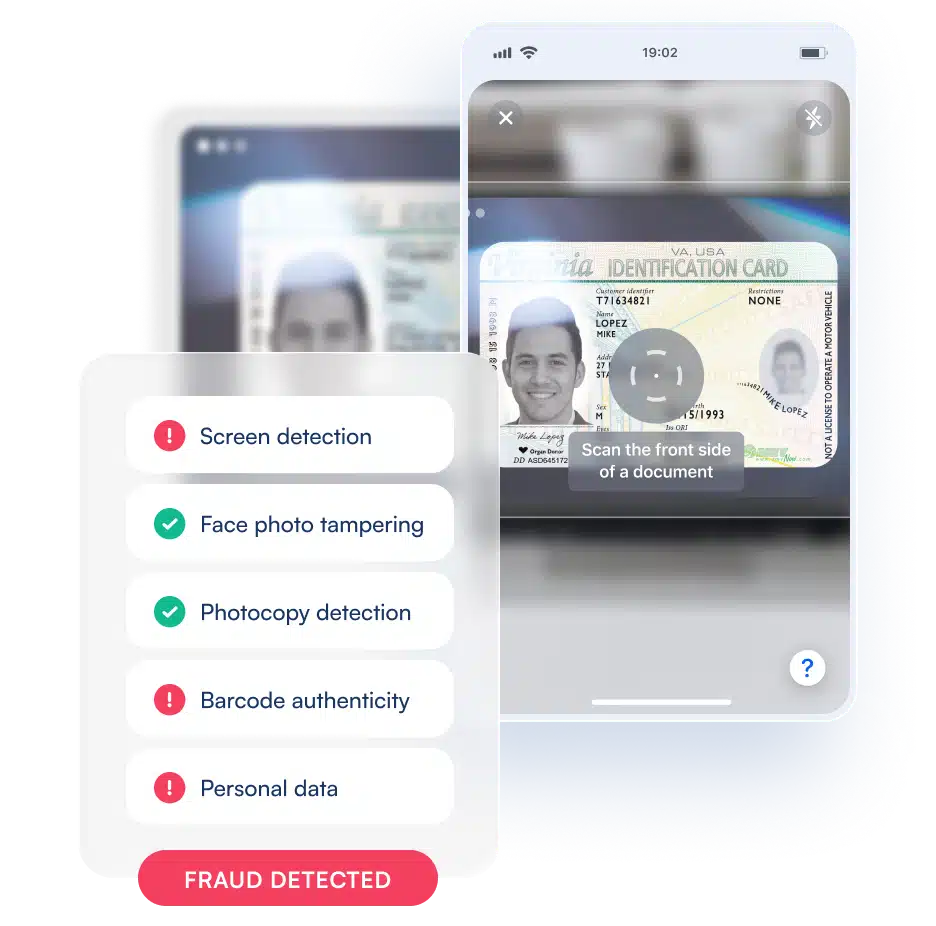
- AI-Powered Document Verification: Instantly scans and verifies government-issued IDs from 140+ countries, detecting fraudulent and synthetic identities.
- Advanced Liveness Detection: Biometric analysis thwarts deepfakes, masks, and static photo attacks, ensuring the presenter is the true owner.
- Real-Time Processing & Decisioning: On-device AI delivers instant verification, enabling frictionless onboarding and immediate risk flagging.
- Integrated AML/KYC Screening: Seamlessly transitions from document capture to global banking AML software and watchlist screening for comprehensive compliance.
Primary Use Cases
- Financial Services Onboarding: Securely verify advisors, brokers, and representatives via a digital onboarding API for KYA/AML compliance.
- Gig Economy & Marketplace Vetting: Confirm identities of drivers, couriers, and service providers during onboarding and re-verification.
- Insurance Agent Authentication: Automate field agent verification to prevent fraudulent policy creation and claims.
Recent Updates
- Next-generation features for adaptive image capture and improved AI accuracy (2025)
- Expanded global document coverage and enhanced user experience
- Rebranding of receipt intelligence line to « Actual » for clearer product distinction
Limitations
- Orchestration capabilities are newer compared to legacy decision engines
- No built-in manual review interface for human-in-the-loop agent auditing
- Primarily focused on identity and access management (IAM)
2. Trulioo

Platform Summary
Trulioo has positioned itself as a pioneer in the agentic space with its dedicated « Know Your Agent » (KYA) framework. Unlike traditional KYC, which focuses solely on the end-user, Trulioo’s approach emphasizes the verification of the AI agent itself and the developer responsible for its code. This creates a multi-layered trust environment where the agent’s origin, integrity, and intent are all verified before a transaction occurs.
The centerpiece of their offering is the Digital Agent Passport (DAP), which acts as a tamper-proof credential for AI agents. For risk managers, this provides a standardized way to evaluate the risk of an autonomous agent, ensuring that it is operating within its defined consent parameters and has not been tampered with since its creation.
Core Features
- Digital Agent Passport (DAP): Cryptographically signed token identifying the agent, its developer, and authorized capabilities.
- Agent Developer Verification: Applies rigorous KYB standards to entities building AI agents.
- Continuous Agent Lookup: Real-time verification of an agent’s status at the moment of transaction.
Primary Use Cases
- Verifying AI agent origins for secure payment access
- Cross-border merchant compliance with standardized agent verification
- Real-time consent capture for agent-authorized actions
Recent Updates
- Released comprehensive KYA framework (2025)
- Strategic collaboration with Worldpay to implement KYA safeguards in payment processing
Limitations
- Integration complexity may require significant infrastructure changes
- Cost may be prohibitive for small-scale deployments
- Data coverage varies by region
3. DataVisor

Platform Summary
DataVisor specializes in defending against the most sophisticated forms of agentic fraud through the use of Unsupervised Machine Learning (UML). While traditional systems rely on historical data to identify known threats, DataVisor’s UML technology analyzes vast amounts of data in real-time to spot coordinated patterns of suspicious behavior. This is particularly effective against « agentic » attacks where bots may behave in novel ways that have never been seen before.
For enterprise Fraud Decision-Makers focused on fintech fraud prevention, DataVisor provides a holistic view of the threat landscape. By integrating fraud detection and AML into a single platform, it allows organizations to catch both individual fraudulent transactions and large-scale bot attacks that attempt to exploit autonomous commerce systems.
Core Features
- Unsupervised Machine Learning (UML): Detects emerging fraud patterns and coordinated bot attacks without labeled historical data.
- Agentic AI for Investigations: Generative AI-powered co-pilot automates fraud alert triage and provides actionable summaries.
- Unified Fraud and AML Platform: Correlates identity, behavioral, and financial data for a 360-degree risk view.
Primary Use Cases
- Detecting unknown attack vectors from novel agentic fraud
- Automated alert triage for high-volume agentic commerce
- Real-time payment interdiction to block fraudulent transactions
Recent Updates
- Integrated Generative AI for automated rule tuning and investigation summaries (2025)
- Enhanced « Agentic AI » capabilities for faster analyst resolution
Limitations
- Strategic onboarding required to maximize value
- Resource-intensive, best suited for large enterprises
- Complexity may be excessive for simple use cases
4. Sift

Platform Summary
Sift focuses on « Digital Trust » by leveraging a massive global data network to analyze behavioral patterns. By tracking billions of events across thousands of sites, Sift can identify whether an agent is acting like a legitimate user or a malicious bot. This behavioral approach is essential for agentic commerce, where the line between a helpful AI assistant and a harmful automated script can be incredibly thin.
The platform is designed to provide « dynamic friction, » meaning it only challenges interactions that appear high-risk. For Fraud Decision-Makers, this ensures that legitimate agents can complete tasks quickly and efficiently, while suspicious agents are met with additional verification requirements or blocked entirely.
Core Features
- Global Data Network: Shares signals across its customer base to identify bad actors based on cross-platform behavior.
- Dynamic Friction: Adjusts user/agent experience in real-time based on risk score.
- Account Takeover Protection: Detects when agents exploit stolen credentials or hijack accounts.
Primary Use Cases
- Behavioral anomaly detection for compromised agents
- Payment fraud prevention for agent-initiated transactions
- Content abuse monitoring to prevent agent-driven spam or fraud
Recent Updates
- Expanded deepfake detection capabilities (2025)
- Broadened partner ecosystem for more diverse data ingestion
Limitations
- Models may require tuning to reduce false positives in high-velocity environments
- Heavily reliant on supervised learning, which may lag against new attack vectors
- Primarily transaction-focused
5. Alloy

Platform Summary
Alloy acts as the « central nervous system » for identity and fraud decisioning. Rather than being a single data source, Alloy is an orchestration platform that allows organizations to connect multiple KYA, KYC, and KYB tools into a single, cohesive workflow. This is vital for FDMs who need to manage a complex stack of tools to verify both the human user and the AI agent developer.
With Alloy, risk teams can build complex logic flows that determine how an agent is verified based on the transaction’s value, the agent’s origin, and other risk signals. This flexibility allows businesses to adapt their KYA strategies quickly as the landscape of agentic fraud evolves, without needing to rewrite their core integration code.
Core Features
- Identity Decisioning Engine: Low-code environment for creating and testing agent verification rules.
- Journey Orchestration: Maps the entire agent lifecycle from onboarding to transaction monitoring.
- Global Data Source Integration: Single API to access a wide range of global identity, document, and behavioral data sources.
Primary Use Cases
- Centralized risk management with unified dashboards
- KYB for agent developers to ensure compliance
- Multi-vendor data logic for regional or risk-based verification
Recent Updates
- Expanded global data source integrations (2025)
- New features for credit underwriting alongside fraud decisioning
Limitations
- Configuration overhead for complex workflows
- Not a data originator—requires contracts with underlying providers
- Internal resources needed for workflow design and maintenance
Next Steps
Selecting the right KYA software is critical for Fraud Decision-Makers tasked with securing agentic commerce. For a deeper dive into how identity-first verification can transform your fraud prevention strategy, explore our in-depth guide to AI-powered onboarding. If you’re ready to see how Microblink can help your organization build a trusted agent network, request a demo today.
Frequently Asked Questions
What is Know Your Agent (KYA) and how does it differ from traditional KYC?
Know Your Agent (KYA) is a framework designed to verify the identity, origin, and integrity of non-human actors such as AI agents, bots, and autonomous scripts. Unlike traditional Know Your Customer (KYC), which focuses on verifying human users, KYA extends verification to the software agents acting on behalf of individuals or organizations. This includes ensuring the agent is authorized, its code is untampered, and its actions align with legitimate intent. KYA is essential for preventing agentic fraud in environments where AI agents can initiate transactions, manage accounts, or access sensitive data autonomously.
Why is KYA software important for agentic fraud prevention?
KYA software is crucial for agentic fraud prevention because it addresses new vulnerabilities introduced by autonomous AI agents. Without robust KYA controls, businesses are at risk of sophisticated synthetic fraud, unauthorized agent access, and large-scale account takeovers that can occur at machine speed. KYA solutions provide advanced identity verification, behavioral analysis, and code integrity checks to ensure that only legitimate, authorized agents can interact with critical systems, reducing the risk of fraud and unauthorized actions.
What features should Fraud Decision-Makers prioritize when selecting KYA software?
Fraud Decision-Makers should prioritize KYA software that offers:
- Identity-First Verification: The ability to link AI agents back to verified human or legal entities using high-assurance ID checks.
- Behavioral Analysis: Tools that analyze how agents interact with APIs and platforms, detecting anomalies that may indicate fraudulent or unauthorized activity.
- Agent Integrity and Provenance: Features like Digital Agent Passports or cryptographic tokens that ensure the agent’s code and permissions have not been altered.
- Real-Time Processing: Low-latency verification to match the speed of autonomous transactions.
- Integration and Orchestration: The ability to combine multiple data sources and risk signals for comprehensive decision-making.
How does KYA software handle the verification of AI agents and their developers?
KYA software verifies AI agents by issuing digital credentials (such as Digital Agent Passports) that cryptographically link the agent to its developer and define its authorized capabilities. The software also applies KYB (Know Your Business) standards to the developers or organizations building the agents, ensuring they meet compliance requirements. Continuous monitoring and real-time lookups are used to confirm the agent’s status and detect any unauthorized changes or suspicious behaviors before allowing transactions to proceed.
Can KYA solutions integrate with existing fraud prevention and compliance systems?
Yes, most leading KYA solutions are designed to integrate with existing fraud prevention, KYC, and compliance systems. Platforms like Alloy offer orchestration capabilities that allow organizations to connect multiple verification tools, data sources, and risk engines into a unified workflow. This integration ensures that both human users and AI agents are subject to consistent, comprehensive verification processes, helping organizations adapt to evolving fraud threats without overhauling their entire technology stack.
How to Choose the Best KYA Software Provider
Selecting the right KYA software provider requires a methodical evaluation of key capabilities. First, assess the platform’s data sources and onboarding depth—does it offer comprehensive checks against global sanctions lists, Politically Exposed Persons (PEPs), adverse media, and criminal records? Second, prioritize solutions with real-time, continuous monitoring and advanced behavioral analytics that can flag anomalous agent activity post-onboarding. Third, evaluate integration capabilities; the best providers offer flexible APIs that seamlessly connect with your existing CRM, payment gateways, and core compliance infrastructure. Finally, consider the platform’s scalability and customization, ensuring it can grow with your agent network and allows you to configure risk models and rules specific to your industry and business logic.