
Fraud Prevention API: Detect Synthetic Identity & Document Fraud Fast

Fraud has outgrown rules engines and manual review queues. Synthetic identities, stolen credentials, and automated attacks now move faster than most onboarding workflows can respond. For fraud leaders, the challenge is no longer whether to use an API-driven approach, but how to select a fraud prevention API that can accurately detect sophisticated threats while keeping friction low for legitimate customers.
A modern payment fraud prevention API must do more than flag anomalies. It needs to understand identity context, detect manipulation in real time, and integrate seamlessly into existing systems without introducing latency, operational risk, or compliance gaps. This article breaks down what to look for, how APIs reduce false positives, and how platforms like Microblink help teams modernize fraud prevention without rewriting their entire stack.
What Is a Fraud Prevention API and Why It Matters Now
A fraud prevention API is a programmable interface that allows organizations to embed fraud detection and identity verification directly into digital workflows. Instead of routing applications to manual review or siloed tools, decisions can be made automatically during onboarding, payment authorization, or account changes.
What has changed is the threat landscape. Synthetic identity fraud now accounts for a growing share of financial crime losses, particularly in digital-first environments. These identities blend real and fabricated data, often passing traditional checks like credit headers or basic document validation. Legacy tools were not designed to detect these composite identities at scale, which is why API-based, machine learning-driven approaches are becoming table stakes.
An effective API fraud prevention strategy allows teams to move from reactive investigation to proactive risk assessment, reducing exposure without sacrificing customer experience.
Core Features Every Fraud Prevention API Should Have
At a minimum, a fraud prevention API must support REST-based integration that allows teams to embed identity checks directly into onboarding and payment workflows. Flexibility matters here. APIs should support synchronous real-time decisions as well as asynchronous workflows for higher-risk cases.
Automation is the second non-negotiable. Manual review introduces delay, inconsistency, and human error. Modern APIs rely on machine learning models that continuously adapt to emerging fraud patterns, allowing organizations to automate low-risk approvals while escalating only genuinely suspicious cases.
Security and compliance are equally critical. Fraud prevention APIs handle highly sensitive personal data, which means strong encryption, secure authentication, and clear data governance policies are essential. From a compliance standpoint, APIs should support KYC and AML requirements across jurisdictions, with audit-friendly outputs that demonstrate how decisions were made.
Addressing Synthetic Identity Fraud at the API Level
Synthetic identity fraud is particularly difficult to detect because it exploits gaps between systems. Fraudsters combine legitimate data points, such as real Social Security numbers, with fabricated names, addresses, or biometric artifacts. Point solutions that verify only one signal are easily bypassed.
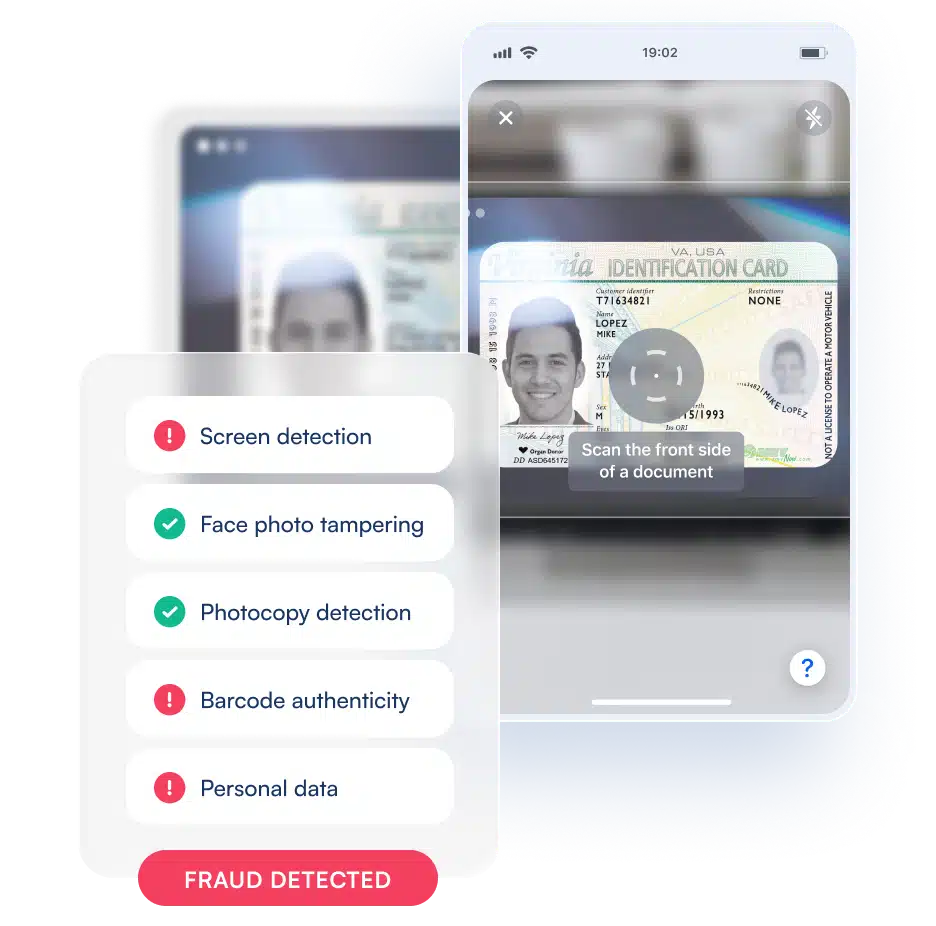
A robust fraud prevention API addresses this by correlating multiple identity signals in real time. This includes government-issued ID verification, document authenticity checks, facial biometrics, and behavioral or device-level indicators. Machine learning models trained on synthetic identity patterns can detect inconsistencies that rule-based systems miss, such as subtle document tampering or biometric mismatches.
Microblink’s identity platform is designed specifically for this challenge. By combining advanced document verification, face matching, and cross-signal risk analysis in a single API layer, it enables teams to detect synthetic and stolen identities early in the onboarding process, before accounts are funded or transactions occur.
How Fraud Prevention APIs Reduce False Positives
False positives are not just an operational nuisance. They drive customer abandonment, increase review costs, and erode trust. Many organizations accept high false positive rates as the cost of security, but modern APIs are changing that equation.
API-driven fraud prevention allows decisions to be contextual rather than binary. Instead of rejecting an application based on a single failed check, systems can evaluate the full identity profile. Machine learning models weigh signals dynamically, reducing the likelihood that legitimate users are incorrectly flagged.
Microblink’s approach emphasizes accuracy over volume. By validating identity documents at the pixel level and matching them against live facial biometrics, the platform reduces reliance on brittle heuristics. The result is fewer unnecessary step-ups and a smoother onboarding experience for legitimate customers, without relaxing risk thresholds.
Integrating a Fraud Prevention API Into Existing Systems
Integration is often where promising fraud tools fail. A fraud prevention API should be designed to fit into existing architectures, not force a redesign. REST APIs with clear documentation, SDK support, and configurable workflows are essential for minimizing implementation time.
Latency is another critical consideration. Fraud decisions must occur fast enough to avoid degrading user experience, particularly during payments or real-time onboarding. Best-in-class APIs operate within strict latency benchmarks and support regional deployment to reduce network delays.
Reliability matters just as much. High availability, failover strategies, and real-time monitoring should be standard. Fraud prevention systems are mission-critical, and downtime can quickly translate into lost revenue or increased fraud exposure.
Performance, Uptime, and Operational Best Practices
Fraud prevention APIs should be evaluated not just on detection rates, but on operational performance. Consistent low latency ensures that identity checks do not become a bottleneck. Clear SLAs around uptime and response times provide confidence that the system will perform under peak load.
Monitoring and observability are often overlooked but essential. APIs should provide logs, metrics, and alerting hooks so fraud teams can understand system behavior and quickly investigate anomalies. This transparency also supports compliance audits, where demonstrating control effectiveness is as important as the controls themselves.
Microblink’s platform is built with enterprise-grade performance in mind, supporting real-time decisioning while maintaining high availability across global deployments.
How to Evaluate Fraud Prevention API Vendors
Choosing a fraud prevention API is a long-term decision. Beyond feature lists, teams should evaluate how well a vendor supports their risk strategy, compliance obligations, and growth plans. Trial environments and proof-of-concept testing are invaluable for validating accuracy and integration effort.
The table below outlines key criteria fraud leaders should use when comparing vendors.
| Evaluation Criteria | What to Look For | Why It Matters |
|---|---|---|
| Detection Accuracy | Proven performance against synthetic and stolen identities | Reduces fraud losses without increasing false positives |
| API Integration | REST APIs, SDKs, clear documentation | Lowers implementation time and engineering effort |
| Automation Capabilities | Real-time decisioning with configurable workflows | Minimizes manual review and operational cost |
| Compliance Support | KYC/AML alignment and audit-ready outputs | Reduces regulatory risk and audit friction |
| Performance & Uptime | Low latency, high availability, clear SLAs | Protects customer experience and revenue |
| Vendor Transparency | Explainable decisions and monitoring tools | Builds trust with regulators and internal stakeholders |
Why a Unified Identity Platform Matters
One of the most common mistakes organizations make is stitching together multiple point solutions to address fraud. This approach increases complexity, creates blind spots, and often leads to inconsistent decisions across the customer lifecycle.
Microblink’s identity intelligence platform takes a different approach. It unifies document verification, biometric authentication, and risk analysis into a single fraud prevention API layer. This allows fraud teams to apply consistent logic across onboarding, payments, and account management, improving both security and customer experience.
For Directors of Fraud Prevention who are accuracy-focused, efficiency-driven, and risk-averse, this unified model reduces vendor sprawl while strengthening control effectiveness.
Final Thoughts
Fraud prevention APIs are no longer optional for organizations facing modern identity and payment fraud threats. The right API can dramatically improve detection of synthetic identities, reduce false positives, and streamline onboarding workflows without compromising compliance.
The key is selecting a solution that combines advanced identity verification, automation, and enterprise-grade performance in a single platform. Microblink’s fraud prevention API exemplifies this approach, helping organizations stay ahead of evolving threats while delivering a frictionless experience to legitimate customers. To learn more, get in touch today.