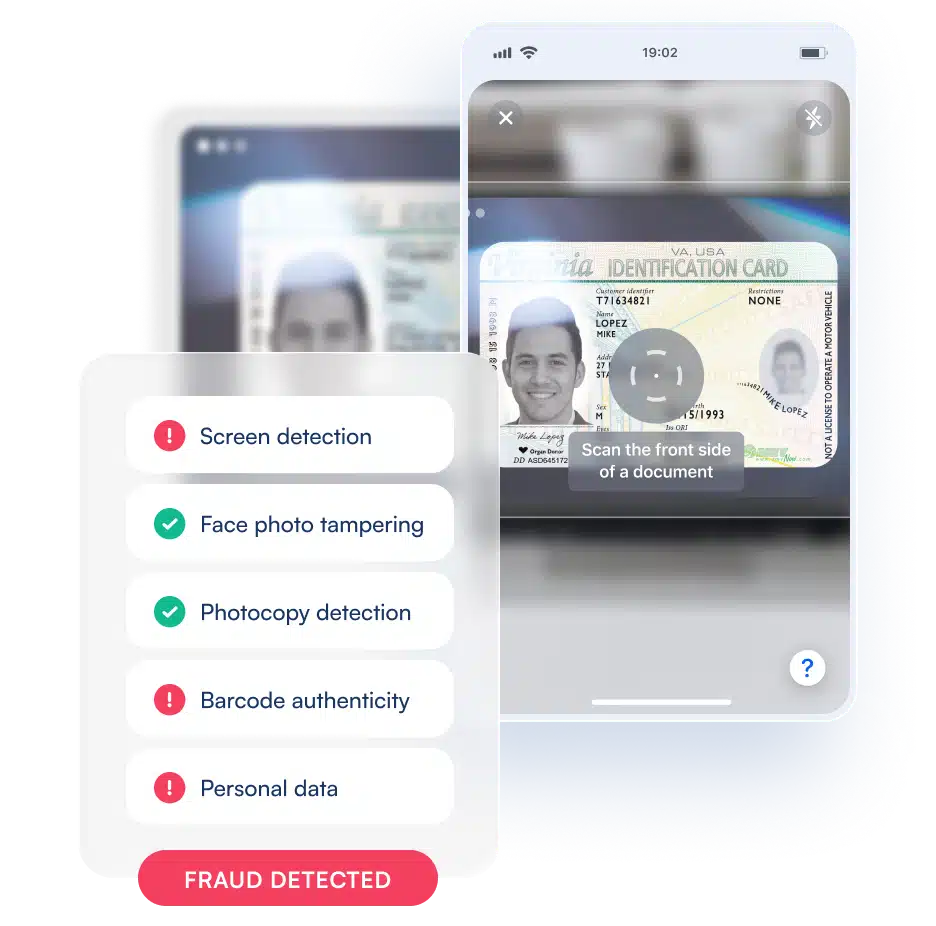

Protect Your Business with CNP Fraud Detection Software

Fraud is one of the biggest risks facing banks and financial institutions year after year. Per Nasdaq’s 2024 Global Financial Crime Report, fraud accounted for $485.6B in banking losses globally in 2023 alone.
And one of the most prevalent schemes is card not present (CNP) fraud.
According to Mastercard, CNP accounted for 70% of all credit card fraud in 2020, but that was just the start—93% of businesses surveyed saw an uptick in it in 2021, and identity theft (a leading cause for CNP) rose in 2022.
This is why fraud detection software plays a critical role in securing businesses and consumers against the threat of financial harm.
What is CNP fraud detection software?
Simply put, CNP prevention software is a suite of solutions that aim to detect, identify, prevent, and mitigate harm from CNP fraud attacks.
A CNP attack occurs when a criminal uses stolen card information to make a purchase, posing as the authorized cardholder (typically online or over the phone). Since no physical card is needed, the attacker only needs critical information like the individual’s name, card number, expiration date, and CVV to succeed.
Some of the best fraud prevention technology solutions are tools for:
- Verifying cards and card information
- Analyzing cardholder behavior and context
- Comparing against purchase/order history
- Monitoring for suspicious transactions
- Detecting changes in communication
Collectively, these tools secure online shopping for buyers and sellers alike, improving online transaction security for everyone it touches.
Benefits of CNP fraud detection software
Fraudulent transactions from CNP or other vectors cost businesses money. Customers who were frauded work with card issuers (i.e., banks) to have their funds accounted for, which typically means “chargebacks” for merchants who unwittingly processed the fraudulent transactions.
Chargebacks are more problematic than simple refunds, though.
After accounting for inventory, processing, and other fees, the true cost of fraud for businesses is approximately 3.6x the dollar amount spent, an increase from the pre-pandemic rate of approximately 3.13x.
There are also long-term impacts related to compliance and reputational damage. CNP can trigger noncompliance penalties associated with the Payment Card Industry (PCI) Data Security Standards (DSS), enforced by Visa, Mastercard, etc.
Investing in sound fraud prevention and security staves off these impacts and protects businesses’ bottom lines—and customers. That said, it’s worth brushing up on insights on enhancing eCommerce security.
Features to look for in CNP fraud detection and CNP fraud prevention software
Companies winning the battle against CNP fraud are implementing robust, flexible digital payment fraud detection software solutions.
The best e-commerce fraud solutions feature:
- Capabilities for collecting and analyzing payment data
- Insights into cardholder behavior, location, and logistics
- User interface functions for swift, frictionless payments
Artificial intelligence (AI), itself powered by machine learning (ML), makes all of these features tick. ML systems trained on relevant data, such as fraud threat intelligence, can leverage computing power to process information far more swiftly than manual processes. That speed translates into volume that AI-assisted systems can handle with ease.
The automation that AI powers does more than make payment fraud prevention easier; it also makes it more accurate, even at scale. That’s why AI and ML power the best CNP and broader fraud detection systems—see how Microblink’s technology powers secure transactions.
How to integrate CNP fraud detection software
Integrating CNP fraud prevention with existing payment processing and customer relationship management (CRM) means enabling dynamic communication and reporting across all systems.
All data points connected to online purchases inform fraud detection.
Transaction data, user behaviors, regular purchase and communication cadence, and other elements need to be collected and analyzed in real time. Ideally, card information (including CNP and scans of actual cards) should be verified by comparing against counterfeit databases.
Other best practices for CNP fraud prevention begin with diving deeply into the context and impact of CNP fraud. Understanding how and why attackers target the users and businesses that they do will improve your chances of stopping them. Companies can leverage identity verification technology at the most advanced levels to authenticate cardholders.
These strategies allow companies to overcome challenges in implementing and maintaining CNP fraud prevention.
The future of CNP fraud detection
Looking ahead, CNP fraud attempts are expected to increase in severity dramatically in the near future. Per one report, total CNP fraud losses will grow 40% by compound annual growth rate (CAGR) by 2028.
To keep up, businesses in every industry will need to stay ahead of emerging financial cybersecurity trends in fraud detection software.
Microblink offers one of the best ways to stay ahead of the curve.
With BlinkCard, organizations can verify payment information accurately in real-time and at scale, making attacks less likely. Prevent up to 95% of CNP fraud and easily optimize the customer experience.
To learn more about how we can help, get in touch!