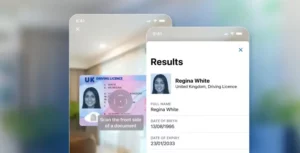

What is Facial Biometrics?
Facial biometrics is a specialized authentication technology that uses advanced algorithms to analyze and verify unique facial features of individuals for identity verification purposes. Unlike general facial recognition used for identification in surveillance, facial biometrics focuses specifically on one-to-one verification to confirm a person’s claimed identity.
The technology involves capturing and analyzing distinctive facial patterns, such as the distance between the eyes, shape of the nose, contours of the face, and jawline structure. These patterns are then converted into mathematical representations known as biometric templates or face templates, which serve as unique digital fingerprints for each individual.
How Facial Biometrics Works
Facial biometric authentication follows a systematic process to verify identity:
1. Image Capture and Preprocessing
- High-resolution cameras capture facial images in real-time
- Image preprocessing enhances quality by adjusting lighting, contrast, and resolution
- Face detection algorithms locate and isolate the face within the captured image
2. Facial Landmark Detection
- Advanced algorithms identify key facial landmarks (typically 68-128 points)
- Critical points include eye corners, nose tip, mouth edges, and facial contours
- These landmarks serve as reference points for feature extraction
3. Feature Extraction and Template Creation
- Biometric algorithms analyze geometric relationships between facial landmarks
- Unique facial characteristics are converted into mathematical vectors
- A biometric template is created containing encrypted facial feature data
4. Matching and Verification
- The captured template is compared against the enrolled reference template
- Matching algorithms calculate similarity scores between templates
- A confidence score determines if the match exceeds the verification threshold
- Liveness detection ensures the person is physically present (not a photo or video)
5. Authentication Decision
- System accepts or rejects the verification attempt based on matching threshold
- Confidence scores typically range from 0-100%, with thresholds set around 70-90%
- Failed attempts may trigger additional security measures or alternative authentication
Applications and Use Cases Across Industries
Financial Services and Banking
- Mobile banking app authentication
- ATM access without cards
- Account opening and KYC (Know Your Customer) verification
- Fraud prevention for high-value transactions
- Branch security and customer identification
Healthcare
- Patient identification and medical record access
- Prescription verification and controlled substance dispensing
- Healthcare worker authentication for sensitive areas
- Telemedicine identity verification
- Medical device access control
Physical Access Control
- Building entry and exit management
- Secure facility access (data centers, laboratories)
- Time and attendance tracking
- Visitor management systems
- Multi-factor authentication for high-security areas
Travel and Transportation
- Airport security and border control
- Passport-free travel programs
- Hotel check-in automation
- Car rental verification
- Public transportation access
Retail and E-commerce
- Point-of-sale customer verification
- Age verification for restricted purchases
- Loyalty program authentication
- Return and exchange verification
- Loss prevention and fraud detection
Technology and Consumer Devices
- Smartphone and tablet unlocking
- Laptop and computer login
- Smart home device authentication
- Gaming console user verification
- Wearable device security
Technical Methods and Implementation
2D vs 3D Facial Biometrics
2D Facial Biometrics:
- Uses standard RGB cameras for image capture
- Analyzes facial features from a single plane
- More susceptible to spoofing with photos or videos
- Lower implementation cost and complexity
3D Facial Biometrics:
- Employs depth sensors and infrared cameras
- Creates three-dimensional facial maps
- Enhanced security against spoofing attempts
- Higher accuracy but increased system complexity
Matching Thresholds and Confidence Scores
- False Acceptance Rate (FAR): Probability of incorrectly accepting an unauthorized user
- False Rejection Rate (FRR): Probability of incorrectly rejecting an authorized user
- Equal Error Rate (EER): Point where FAR and FRR intersect, indicating optimal threshold
- Adjustable thresholds balance security and user convenience
Accuracy, Performance, and Technical Limitations
Performance Metrics
- Modern facial biometric systems achieve 95-99% accuracy under optimal conditions
- Verification typically completes within 1-3 seconds
- Template sizes range from 1-10 KB for efficient storage and processing
Environmental Factors Affecting Accuracy
- Lighting conditions: Poor or inconsistent lighting reduces recognition accuracy
- Camera angle and distance: Optimal performance requires proper positioning
- Image quality: Low resolution or blurry images impact feature extraction
- Facial expressions: Extreme expressions may affect landmark detection
Technical Limitations
- Aging effects: Facial changes over time may require template updates
- Demographic bias: Some systems show varying accuracy across different ethnic groups
- Identical twins: High facial similarity can challenge verification accuracy
- Facial hair and accessories: Significant changes in appearance affect recognition
- Spoofing vulnerabilities: 2D systems remain susceptible to photo and video attacks
Privacy, Security, and Legal Considerations
Data Protection and Privacy
- Biometric templates are typically encrypted and stored securely
- Many systems use irreversible template formats to prevent reconstruction
- Local processing options reduce data transmission risks
- User consent requirements for biometric data collection and processing
Regulatory Compliance
GDPR (General Data Protection Regulation):
- Biometric data classified as sensitive personal information
- Explicit consent required for processing
- Right to erasure and data portability obligations
CCPA (California Consumer Privacy Act):
- Biometric identifiers considered personal information
- Consumer rights to know, delete, and opt-out of data sales
BIPA (Biometric Information Privacy Act):
- Illinois law requiring informed consent for biometric collection
- Specific retention and destruction requirements
- Private right of action for violations
Security Measures
- End-to-end encryption for data transmission
- Secure element storage for biometric templates
- Multi-factor authentication combining biometrics with other factors
- Regular security audits and vulnerability assessments
- Liveness detection to prevent spoofing attacks
Compliance Obligations
- Clear privacy policies explaining biometric data usage
- Secure data storage with appropriate access controls
- Regular deletion of biometric data when no longer needed
- Incident response procedures for data breaches
- User rights management for consent withdrawal
Facial biometric technology continues to advance with improvements in accuracy, security, and user experience, making it an increasingly viable solution for secure authentication across diverse applications while requiring careful attention to privacy and regulatory requirements.