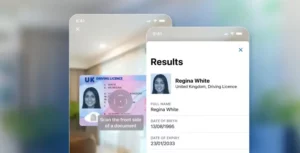

What is Facial Deduplication in Identity Verification?
Facial deduplication is a biometric technology that prevents duplicate identities by comparing facial features across a database to ensure each person can only have one verified account or record in an identity verification system. This technology plays a critical role in fraud prevention and regulatory compliance by detecting when the same individual attempts to create multiple accounts or identities within a system.
Understanding Facial Deduplication Technology
Facial deduplication is a specialized biometric process that creates unique facial signatures to identify and prevent duplicate identities across verification systems. Unlike other facial biometric technologies, its primary purpose is ensuring identity uniqueness rather than identification or authentication.
The technology operates by creating biometric templates from facial images rather than storing actual photographs. These templates serve as unique digital fingerprints that can be compared against existing records to detect potential duplicates. This approach protects user privacy while maintaining the ability to identify duplicate enrollment attempts.
To understand facial deduplication’s unique role, it’s important to distinguish it from related biometric technologies:
| Technology Type | Primary Purpose | Key Question Answered | Typical Use Case
|
|---|---|---|---|
| Facial Recognition | Identify who someone is | «Who is this person?» | Access control, surveillance systems |
| Facial Verification | Confirm claimed identity | «Is this the person they claim to be?» | Account login, identity document verification |
| Facial Deduplication | Prevent duplicate identities | «Has this person already enrolled?» | Account creation, fraud prevention |
Key characteristics of facial deduplication include:
- Prevention-focused approach: Blocks duplicate account creation before it occurs
- Template-based processing: Uses mathematical representations rather than storing facial images
- Database-wide comparison: Checks against all existing records in the system
- Threshold-based matching: Uses configurable similarity scores to determine potential duplicates
- Integration capability: Works within broader identity verification workflows
The Technical Process Behind Duplicate Detection
The facial deduplication process involves several technical steps that work together to detect potential duplicate identities in real-time. Understanding this workflow is essential for organizations implementing the technology.
The process follows a structured sequence from initial image capture through final duplicate detection decision:
| Process Step | Technical Action | Data Involved | Decision Point | Output/Result
|
|---|---|---|---|---|
| 1. Image Capture | Facial image acquisition during enrollment | Raw facial photograph | Image quality assessment | Accepted/rejected image |
| 2. Template Extraction | Biometric feature extraction using ML algorithms | Facial landmarks and features | Feature quality validation | Biometric template |
| 3. Database Query | Search existing templates for similar patterns | Template comparison vectors | Similarity threshold settings | Potential match candidates |
| 4. Similarity Scoring | Calculate match confidence scores | Numerical similarity values | Configurable match thresholds | Match/no-match decision |
| 5. Duplicate Detection | Final determination of duplicate status | Combined scoring results | Business rule application | Allow/block enrollment |
The system processes facial images by extracting distinctive features such as the distance between eyes, nose shape, and jawline contours. These features are converted into mathematical templates that enable rapid comparison without storing identifiable facial images.
Real-time processing capabilities allow immediate duplicate detection during the enrollment process. This prevents users from completing registration if a potential duplicate is detected, maintaining system integrity from the moment of initial interaction.
Integration points within identity verification workflows typically occur during:
- Initial account creation: Primary checkpoint for new user enrollment
- Document verification: Cross-reference with ID document photos
- Ongoing monitoring: Periodic checks for newly detected duplicates
- Administrative reviews: Manual verification of flagged potential matches
Business Benefits and Industry Applications
Facial deduplication provides significant value across multiple dimensions, from fraud prevention to operational efficiency. Organizations implement this technology to address specific challenges while meeting regulatory requirements.
The primary benefits organize around four key categories:
| Benefit Category | Specific Benefit | Business Impact | Industries Most Affected
|
|---|---|---|---|
| Security | Fraud prevention through duplicate blocking | Reduced financial losses from multi-account fraud | Financial services, e-commerce |
| Compliance | KYC/AML regulatory requirement support | Avoided regulatory penalties and fines | Banking, cryptocurrency, money services |
| Operational | Cost reduction from fewer duplicate records | Lower customer service and data management costs | Telecommunications, government services |
| User Experience | Streamlined verification without friction | Higher conversion rates and user satisfaction | Digital onboarding, mobile applications |
Real-world applications demonstrate the technology’s versatility across industries:
| Industry/Sector | Primary Challenge Addressed | Implementation Context | Compliance Requirements
|
|---|---|---|---|
| Financial Services | Multi-account fraud and synthetic identities | Account opening and loan applications | KYC, AML, CDD regulations |
| Government Services | Benefit fraud and identity theft | Citizen enrollment and service access | Identity assurance standards |
| Healthcare | Insurance fraud and patient safety | Patient registration and insurance verification | HIPAA, patient identity requirements |
| Telecommunications | SIM card fraud and account abuse | Mobile service activation | Telecom regulatory compliance |
| Cryptocurrency | Exchange fraud and money laundering | Wallet creation and trading accounts | AML, sanctions compliance |
The technology proves particularly valuable in high-risk scenarios where duplicate identities pose significant security or financial threats. Organizations report substantial reductions in fraud-related losses and improved regulatory compliance scores after implementation.
Security benefits extend beyond simple duplicate prevention to include detection of sophisticated fraud attempts using synthetic identities or stolen credentials. This approach addresses evolving fraud techniques that traditional verification methods might miss.
Final Thoughts
Facial deduplication represents a critical component of modern identity verification systems, serving as the first line of defense against duplicate identities and associated fraud. By creating unique biometric signatures and comparing them against existing records, this technology ensures that each individual can maintain only one verified account within a system.
The technical complexity of facial deduplication requires robust machine learning capabilities, which is why many organizations partner with established providers that have extensive computer vision expertise. Successful implementation depends on achieving the right balance between accuracy and user experience, preventing false positives while maintaining security effectiveness.
Organizations implementing facial deduplication often work with specialized identity verification providers to ensure accurate deployment and integration with existing systems. Companies like Microblink, with 12 years of computer vision R&D expertise and comprehensive fraud detection capabilities including presentation attack detection and synthetic identity detection, demonstrate how facial deduplication works most effectively when integrated within broader identity verification workflows rather than as a standalone solution.