
Everything Banks Needs to Know about Financial Fraud Detection

Per the Federal Trade Commission (FTC), consumers lost $10B to financial fraud in 2023, up from $8.8B in 2022. This troubling fraud trend highlights the growing importance of fraud detection, anti-fraud technology, and risk management strategies in the banking sector. It also speaks to how banks can’t rely on customer-end prevention to avoid fraud from occurring outright.
When securing financial transactions against fraud, banks must know what fraud detection looks for in a modern environment, the impacts fraud can have, some key regulatory considerations, and fraud detection techniques and best practices to prevent and mitigate harm.
What is financial fraud detection?
Fraud detection is a foundational pillar of digital transaction security to ensure that all purchases and payments are legitimate. It takes a concerted, joint effort between cybersecurity in banking and fraud prevention measures on the part of merchants to sniff out fraud.
It all starts with knowing what to look for.
Some of the most common kinds of financial fraud are schemes that target consumers, per the Office of the Comptroller of Currency (OCC):
- Advance fee fraud, in which attackers seek up-front payment
- Cashier’s check fraud, abusing trust in the payment form
- Unauthorized banking masquerading as legitimate
- Prime banking fraud using false financial instruments
- Identity theft, which can lead to account takeover fraud
- Phishing for information to facilitate all the above schemes
Fraud can be initiated through other crimes, as theft of physical cards enables using them without authority. In the digital landscape, card not present (CNP) fraud can take as little as access to a cardholder’s name and the card’s number, expiration, and card verification value (CVV).
Hence, banking fraud prevention is essential.
The impact of financial fraud
Fraudulent activity has an outsized and often underestimated impact on banks and financial institutions. A landmark longitudinal study on the effects of fraud found that the impact on credit risk alone has the potential to upend entire financial markets, among other effects.
At the level of individual banks, breaches of financial integrity affect equity prices and deposit flows. The International Monetary Fund (IMF) found that the former fell by ~11% on average following an incident, whereas the latter decreased by ~7% in banks directly impacted.
Further reading on financial fraud trends and prevention shows the prevalence of this matter.
Importantly, payment fraud also carries negative consequences for the individuals targeted and the merchants illegally purchased from.
This is why it takes a combined effort to mitigate fraud risks at scale.
The role of legislative and regulatory bodies in financial fraud detection
The most important regulatory body for anti-fraud enforcement is the Financial Crimes Enforcement Network (FinCEN). Other entities include the respective boards of the Federal Reserve, the Federal Deposit Insurance Corporation (FDIC), and the Securities and Exchange Commission (SEC), which comprise the federal functional regulator.
Concerning regulatory compliance, banks, and financial institutions are accountable to overlapping frameworks to prevent fraud, like the:
- Bank Secrecy Act (BSA) and anti-money laundering (MLA) regulations, which require know your customer (KYC), Customer Identification Program (CIP), and customer due diligence (CDD)
- Uniting and Strengthening America by Providing Appropriate Tools Required to Intercept and Obstruct Terrorism (USA PATRIOT) Act, preventing fraud related to terrorist acts
Just like the joint approach to enforcement shared between multiple agencies, these and other laws form a patchwork of regulations that govern an organization’s fraud detection process. However, it can be challenging to meet all applicable regulations simultaneously.
Fraud detection best practices
To make fraud less likely and mitigate the harm it can cause when attempted, cybersecurity experts recommend training in general security strategies on the threats and vulnerabilities specific to financial fraud.
In practice, that means documenting and disseminating formal fraud prevention policies, such as regular risk assessment and classification.
It also means training staff on the importance of fraud detection and how they can contribute to a culture of vigilance. Any seemingly small inconsistency in a user’s account could indicate fraud or an early warning sign of vulnerability. These details need to be prioritized.
Last but not least, banks should implement comprehensive and flexible fraud prevention tools, like custom-built identity fraud detection and prevention software. The best solutions utilize the power of artificial intelligence (AI) to analyze transactions near-instantaneously. That way, potentially fraudulent transactions can be flagged and addressed as early as possible, minimizing the harm they can cause.
Building a fraud detection framework
Stopping financial fraud and lessening its impacts worldwide will require collaboration between financial institutions, merchants, and consumers. Given the ever-increasing cybercrime threats, banks will be critical in implementing statistical data analysis techniques to detect and prevent fraud.
This all begins with machine learning (ML).
Leveraging ML helps fraud detection perform at the best of its abilities, analyzing huge amounts of data across internal and external datasets.
How Microblink optimizes fraud detection
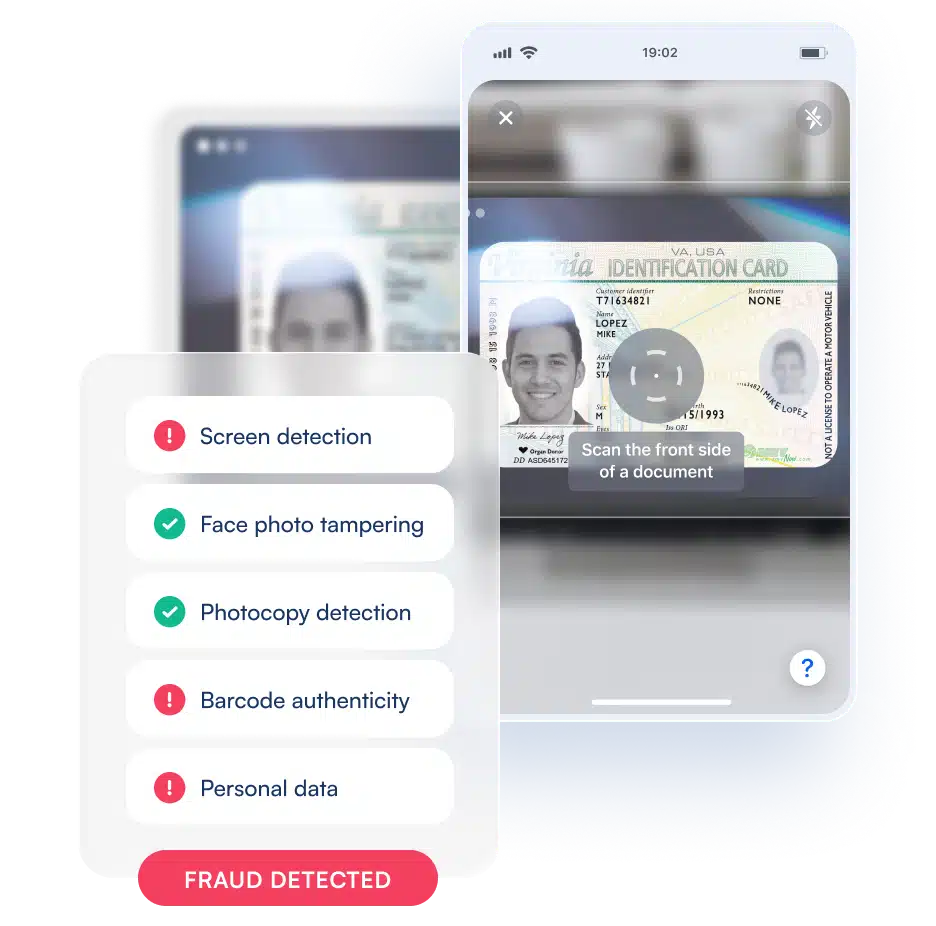
Our BlinkID solutions enable rapid, accurate, on-device ID Scanning in banking to satisfy KYC and CIP requirements.
In addition, our BlinkCard leverages AI in fraud detection to verify cardholder presence and card information, reducing CNP fraud by up to 95%.
Microblink powers effective, efficient fraud detection systems for banks and financial institutions. To learn how we can help, get in touch!