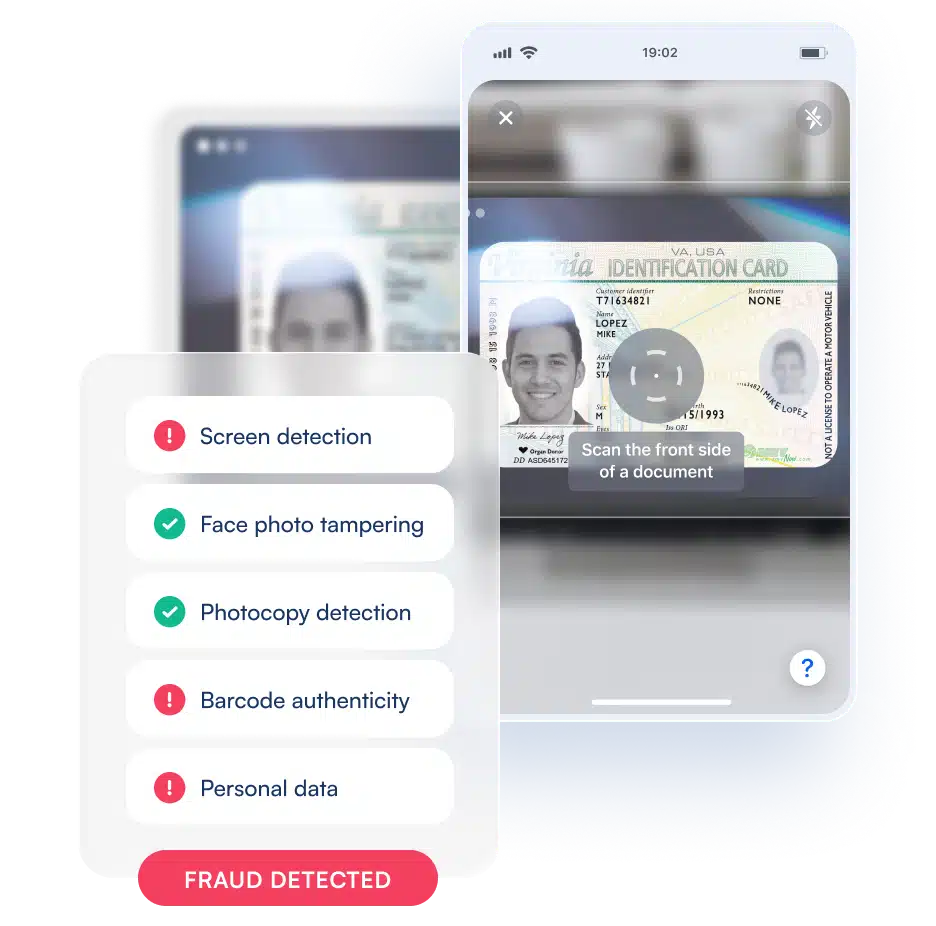

Document Fraud Detection API: Stop Synthetic IDs & Deepfakes Fast

Document fraud has evolved far beyond blurry photocopies and obvious forgeries. Today’s attackers use high-quality templates, digital manipulation, and AI-generated artifacts to slip synthetic identities and deepfakes through onboarding workflows that were never designed to spot them. For risk management specialists, the challenge is clear: how to detect increasingly sophisticated document fraud without increasing friction or failing compliance audits.
A modern document fraud detection API gives organizations the ability to automatically verify identity documents in real time, replacing slow and inconsistent manual review with accurate, scalable decisioning. When implemented correctly, these APIs reduce fraud risk, improve customer experience, and strengthen KYC and AML compliance at the same time.
What Is a Document Fraud Detection API?
A document fraud detection API is a software interface that enables automated verification of government-issued identity documents during onboarding or account changes. Instead of relying on human reviewers to visually inspect documents, the API analyzes images at a technical level to determine whether a document is authentic, manipulated, or entirely synthetic.
Most risk leaders already understand the basic concept. What’s changed is the threat profile. Fraudsters now routinely alter real documents, inject synthetic data, or use deepfake techniques to bypass traditional checks. This is why document fraud detection must be AI-driven, signal-rich, and deeply integrated into identity workflows rather than treated as a standalone step.
Why Manual Document Review No Longer Works
Manual document verification struggles to keep pace with modern fraud. Reviewers are forced to make subjective judgments under time pressure, often with limited context. This leads to inconsistent decisions, high operational costs, and elevated false positive rates that frustrate legitimate customers.
From a compliance standpoint, manual processes are equally risky. Inconsistent reviews make it difficult to demonstrate repeatable, auditable controls during KYC or AML examinations. As onboarding volumes grow, these weaknesses become more pronounced, increasing both fraud exposure and regulatory risk.
Document fraud detection APIs address these issues by applying the same verification logic consistently across every applicant, regardless of volume or geography.
Core Features to Look for in a Document Fraud Detection API
An effective document fraud detection API must be built around automated, AI-driven analysis rather than static rules. Machine learning models should be trained to detect forgery techniques, document tampering, and synthetic identity patterns that are invisible to the human eye.
Deep document analysis is critical. This includes inspecting fonts, layouts, security features, image layers, and metadata to identify signs of manipulation. APIs that only validate surface-level attributes are easy to bypass with modern tools.
Equally important is coverage. A strong API should support a wide range of global identity documents and continuously update its models as new document versions and fraud techniques emerge. Without this adaptability, detection accuracy degrades quickly.
Detecting Synthetic Identities and Deepfakes at the Document Level
Synthetic identity fraud often begins with a convincing document. Fraudsters may combine real document numbers with fabricated names or alter legitimate IDs to create new identities that pass basic checks. Deepfakes add another layer of complexity, allowing attackers to generate highly realistic images that defeat traditional validation.
A modern document fraud detection API combats this by correlating multiple signals during verification. Advanced systems analyze document authenticity while also flagging inconsistencies commonly associated with synthetic identities, such as layout anomalies, unusual data combinations, or subtle signs of digital alteration.
Microblink’s document fraud detection API is designed specifically for this environment. It uses advanced forgery and tampering detection techniques as part of a broader identity platform, enabling organizations to stop synthetic and manipulated documents before they move downstream into payments or account access.
Integrating a Document Fraud Detection API Into Existing Workflows
Integration should not require a complete rebuild of your onboarding process. The strongest document fraud detection APIs are delivered via REST interfaces and SDKs that plug directly into existing identity verification workflows.
Real-time performance is essential. Document verification should happen within seconds, returning clear outcomes that allow systems to automatically approve, reject, or escalate cases. This minimizes customer friction while preserving strong risk controls.
Workflow automation is where APIs deliver the most value. Low-risk cases can be approved instantly, while higher-risk applications are routed for additional checks. This targeted approach dramatically reduces manual review volume without lowering security standards.
Reducing False Positives While Strengthening Compliance
False positives are one of the biggest hidden costs in identity verification. Every unnecessary rejection increases abandonment, support tickets, and brand frustration. Many organizations accept this as inevitable, but document fraud detection APIs change the equation.
By analyzing documents at a technical level rather than relying on surface indicators, APIs can distinguish between legitimate edge cases and genuine fraud. This precision allows risk teams to tighten controls without over-blocking good customers.
From a compliance perspective, automated document verification provides consistent, auditable evidence that identity checks are being applied uniformly. APIs that log verification results and decision rationale make it easier to demonstrate KYC and AML compliance during audits.
Evaluating Document Fraud Detection API Vendors
Not all document fraud detection APIs are created equal. Risk leaders should evaluate vendors based on detection accuracy, integration effort, and operational reliability, not just feature lists.
The table below outlines key criteria to consider when comparing providers.
| Evaluation Criteria | What to Assess | Why It Matters |
|---|---|---|
| Fraud Detection Accuracy | Ability to detect forged, tampered, and synthetic documents | Reduces fraud losses and audit risk |
| AI-Driven Analysis | Use of machine learning over static rules | Improves detection of modern fraud techniques |
| Integration Simplicity | REST APIs, SDKs, and documentation quality | Speeds implementation and lowers engineering cost |
| Global Document Coverage | Support for multiple ID types and regions | Enables scalable onboarding |
| False Positive Control | Precision in distinguishing fraud from legitimate users | Protects conversion rates |
| Compliance Support | Audit-ready outputs and consistent decisioning | Simplifies KYC and AML reporting |
Why a Platform Approach Matters
Many organizations treat document verification as a single checkpoint, but document fraud rarely exists in isolation. It is often the entry point for broader identity fraud, account takeover, or payment abuse.
Microblink’s document fraud detection API is part of a comprehensive identity platform that combines document verification with biometric matching and additional risk signals. This unified approach allows organizations to verify more customers automatically, reduce fraud exposure, and maintain strong compliance while keeping operations efficient.
For accuracy-focused, efficiency-driven, and compliance-conscious risk teams, this platform model delivers better outcomes than stitching together disconnected tools.
Final Thoughts
A document fraud detection API is no longer a nice-to-have. It is a foundational component of modern identity verification strategies, particularly as synthetic identities and deepfakes become more prevalent.
The right API enables organizations to automate document verification, reduce false positives, and strengthen KYC and AML compliance without slowing onboarding. By choosing a solution that combines advanced AI-driven detection with seamless integration, risk leaders can protect both their customers and their growth.