

ID Verification API: The Ultimate Buyer’s Guide

Whether in finance, healthcare, eCommerce, or any industry in between, identity verification is an absolute must-have. Knowing who’s at the other end of a transaction isn’t just nice; it’s non-negotiable. Think about it: would you run a brick-and-mortar store blindfolded? Of course not.
The right automated online identity verification API keeps fraudsters out, helps you stay compliant with regulations, and builds trust with your customers. But not all APIs are created equal and choosing the wrong one can be costly. This guide explains how ID verification APIs work, the features that matter most, and what to look for when selecting the right partner.
What is an ID Verification API?
Think of an API for digital identity verification as your virtual bouncer, always on, always checking IDs, and never taking a break. It connects your platform with an external service that verifies users’ identities through a mix of document checks, biometrics, and data validation.
At a high level, an identity verification API:
- Returns a response with a pass/fail decision or additional signals you can use in your workflow
- Receives data from your application (like an uploaded ID, selfie, or form input)
- Sends it securely to a verification provider
How Identity Verification APIs Work
Behind the scenes, most identity verification APIs follow a similar workflow:
- API Request – Your app sends user-provided data (ID photo, selfie, personal info) to the API endpoint.
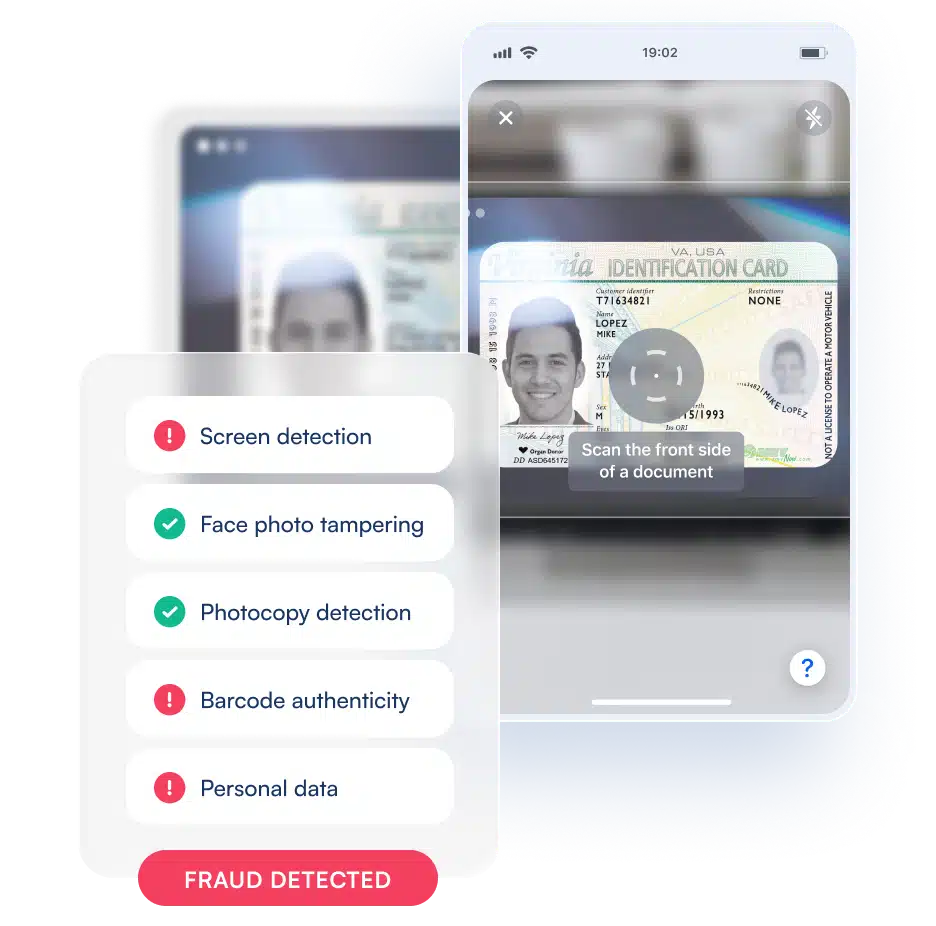
- Document Capture & Parsing – The API scans ID documents using OCR and machine learning to extract fields.
- Biometric & Liveness Checks – A selfie or video ensures the person is real and matches the ID photo.
- Database Validation – User data is cross-checked against trusted databases and watchlists.
- Decision Response – The API returns a verification result you can accept automatically or route for review.
With SDKs, libraries, and webhooks, the whole process can happen in seconds, seamlessly within your app
Multi-Modal Verification
Fraud tactics are evolving, which means a single check isn’t enough. The best ID verification APIs combine multiple layers of verification:
- Document Verification – Scanning government-issued IDs, passports, or licenses.
- Biometric Authentication – Matching selfies or facial scans against ID photos.
- Liveness Detection – Making sure the face on camera is real, not a deepfake or static image.
- Knowledge-Based Challenges – Optional quizzes or extra prompts to confirm identity.
This multi-modal approach reduces false positives while ensuring legitimate customers aren’t blocked.
Risk, Fraud & Compliance Features
An online identity verification API should do more than just check IDs. Look for built-in risk and compliance capabilities, such as:
- Synthetic ID Detection – Catching AI-generated or stitched-together identities.
- Watchlist & Sanctions Screening – Automatic checks against AML and OFAC databases.
- Geolocation & Device Signals – Contextual risk analysis based on login location or device fingerprinting.
- Regulatory Coverage – Support for KYC, AML, GDPR, CCPA, and industry-specific mandates.
These features don’t just protect against fraud, they protect your business from legal and reputational risk.
It’s also important to consider integration options. SDKs & Developer Tools are important to accelerate setup and time to market. No-Code Workflows help non-technical teams that want drag-and-drop customization. The API should also feature real-time webhooks so you can update your platform instantly on verification outcomes and be scalable to handle thousands — or potentially millions — of checks without downtime.

11 best ID verification APIs
When you’re on the hunt for the best ID verification API, it’s like shopping for a new car. You want performance, reliability, and something that fits your unique needs, right?
But the market is flooded with options, and not all are created equal.
Let’s break down some of the leaders in the field to help you make an informed choice. You’ll need more than simple manual verification to ensure your company is compliant and forward-thinking. Here’s a closer look at these APIs.
Microblink
Let’s begin by discussing Microblink and its flagship product, BlinkID. With real-time data extraction, it captures and verifies ID cards, passports, and other documents in a snap. All of this while providing real-time feedback so you can trust the data points you’re collecting.
BlinkID is engineered to do much more than just be an ID-scanning solution. It focuses on real-time data capture and validation.
You take a snap of an ID card or passport, and the software immediately pulls and verifies the necessary information. This isn’t just a time-saver—it’s an essential feature for any business that must trust the data they collect at the point of entry.
What separates BlinkID from similar tools is its built-in liveness detection. When dealing with identity verification, knowing the data comes from a real human being is paramount.
Jumio
Jumio’s ID verification API streamlines the process of capturing and submitting government-issued ID documents, making it easy for customers to perform these tasks securely. The system executes real-time ID verification employing machine learning to help deter fraudulent activities while complying with regulatory mandates.
Jumio enhances this process further by automatically extracting data from the ID document during the verification stage, which contributes to assessing its authenticity. The technology used, including computer vision and AI, checks the ID against various security features, ensuring a thorough verification process.
Onfido
Onfido’s Real Identity Platform provides a comprehensive suite of identity verification products that include document and biometric verifications, trusted data source verifications, and fraud detection signals.
Their document verification technology captures and extracts data from customers’ IDs, enhancing user-friendliness. Plus, Onfido adds a layer of security by incorporating biometric verification.
The system also scrutinizes various security features on the ID, such as watermarks and holograms, and employs optical character recognition technology to extract vital information from the document, like the individual’s name, date of birth, and ID number.
Trulioo
Trulioo, another identity platform, offers a normalized identity API, designed to simplify the integration of verification business logic via RESTful APIs, thereby reducing the likelihood of errors and unexpected results. Trulioo’s offerings extend to identity verification, document verification, and business verification.
Their Identity document verification service verifies government-issued IDs and incorporates liveness and face-comparison biometric tests throughout the verification process.
Through one API, you can verify over 5 billion customers in real-time, which is an impressive stat and can no doubt be instrumental in mitigating the risks associated with identity fraud.
Plaid
Plaid’s identity verification API enables the verification of user identities using bank data, thereby aiding in reducing fraud and helping prevent account takeovers. This system allows for retrieving user names, phone numbers, addresses, and emails for individual and joint accounts, which can significantly complement KYC procedures.
Plaid’s identity verification stitches together various verification methods, covering identification documents, phone numbers, names, dates of birth, ID numbers, and addresses. It’s a comprehensive approach and aims to provide a “one-stop solution” for verifying identity globally against authoritative data sources, authenticating ID documents, confirming liveness, and assessing risk.
Verifai
Verifai offers identity verification solutions tailored to a few different use cases. It’s designed to be easily implemented and customized, adhering to high privacy and security standards. Verifai’s platform integrates into mobile and web applications, making it a versatile choice for identity verification needs.
ID Analyzer
ID Analyzer’s API offers data extraction and facial recognition features for secure identity verification. It’s designed for easy integration and comes with a fake ID check and access to databases for checking AML and PEP. While the API is robust, its performance can be compromised if the uploaded images are of poor quality.
Tracers
Tracers offers an ID verification API that provides easy integration into your current platform, allowing customization to fit your needs. With features like a comprehensive public and private records database, the API enables you to conduct people searches, criminal record checks, and even social media searches without revamping your existing infrastructure.
One key point: Tracers strongly emphasizes customer support, but keep in mind that its capabilities are only as good as the quality of its database. The API is geared towards saving time and reducing risk, fitting well with businesses that need to conduct due diligence swiftly and efficiently.
RapidVerify
RapidVerify presents a no-code solution designed for real-time identity and income verification. Being your typical SaaS platform, RapidVerify offers real-time verification features that streamline the user verification process.
This platform appears to be a straightforward solution for businesses looking to enhance their identity verification processes without the need for extensive coding or technical expertise. However, being too simple can have the adverse effect that its customization might be lacking.
SEON
SEON provides a comprehensive suite of tools covering government ID verification, electronic ID verification, document scanning, and biometrics. Their tools are designed to help you onboard, verify, and future-proof against identity fraud and take care of overall compliance.
SEON’s offerings are available via API and even a WordPress plugin, so you have flexible integration options for different platforms. This makes SEON a versatile choice for businesses looking to bolster their identity verification processes.
DocuSign
DocuSign, which you’re probably familiar with if you’ve ever signed a document online, has recently launched an enhanced identity verification feature called Liveness Detection for ID verification. This new feature applies AI to live video selfies to make the process more convenient while preventing identity spoofing and deep-fakes.
Similar to other AI-based platforms like Microblink, DocuSign adds a layer of real-time verification by incorporating live video selfies, making it a unique and modern solution to identity verification challenges. This new offering from DocuSign reflects the evolving landscape of identity verification technologies, where AI and real-time assessments are being leveraged to enhance security and user experience.
Making the right choice
Choosing the right ID verification API for your business is a pivotal move.
So you’ve made your choice, and now it’s time for the API integration into your existing tech stack. But don’t worry; this process should be relatively painless if you’ve made the right choice.
When it comes to easy integration, the best ID verification APIs out there offer extensive documentation and development support to get you up and running in no time.
Steps to integrate ID verification API
This is where the rubber meets the road. Start by reading any available API documentation and gather all necessary tools and resources. This will give you a clear idea of the endpoints, parameters, and responses the API supports.
Many providers offer SDKs and libraries that can help speed up the process. These tools can help you save time and effort while ensuring your integration is successful.
During the integration phase, you will be required to establish a connection between your system and the API. This involves configuring the necessary settings so that data integrates seamlessly between the two systems.
Additionally, you will need to test the API’s responses to verify they align with your system’s requirements and expectations. Once you have set up the integration and tested the API’s responses, you can ensure that data flows into your system without hiccups.
Necessary tools and resources
This part is all about preparation. Firstly, you’ll need to have a good understanding of your existing system architecture and technical infrastructure. This will help you to identify any potential compatibility issues and ensure the ID verification software can be easily integrated into your current setup.
Secondly, you will need to ensure that you have the appropriate hardware and software resources to support the ID verification software. This may include additional servers, storage devices, and processing power to handle the increased workload.
Thirdly, you’ll need to have a clear understanding of the regulatory requirements and compliance standards related to ID verification. This will help you to ensure that your system is fully compliant and that you can provide a high level of security and protection for your users’ personal information.

Overall, integrating ID verification software into your system can be a complex process. Still, with the right tools and resources, it can be done successfully and with minimal disruption to your existing operations.
Consequences of incorrect integration
We don’t want to sound all doom and gloom, but let’s be real—incorrect integration can have some serious consequences. One of the biggest risks of incorrect integration is it can result in false positives or false negatives.
False positives occur when a legitimate user is mistakenly identified as fraudulent, while false negatives occur when a fraudulent user is mistakenly identified as legitimate. Both scenarios can be detrimental to the user experience and can lead to frustration and loss of trust in the system.
Another consequence of incorrect integration is it can compromise the security of the system. If the API is not properly integrated, it may be vulnerable to attacks like spoofing. Hackers can then use this vulnerability to gain unauthorized access to the system or steal sensitive data.
Furthermore, incorrect integration can also lead to legal and regulatory issues. If a system is not compliant with applicable regulations, such as GDPR or HIPAA, it can result in hefty fines and legal penalties.
Do your homework
In a rapidly digitizing world, the importance of robust ID verification can’t be overstated. It’s not just about ticking boxes for KYC compliance or reducing fraud—though those are critical, too.
It’s about building trust with your customers that sets the tone for your entire relationship with them. Choosing the better customer identity verification software can make or break that trust.
So do your homework. Don’t just settle for the first API you stumble upon. Take it for a test drive, consult your peers, and measure it against your unique needs. Remember, the right API eases your workload and enhances your customers’ experience in real time.
Contact us today to see it for yourself with a demo.
FAQ
What is an identity verification API?
How does an ID verification API work?
What features should I look for in an API for identity verification?
How do I integrate an identity verification API?

Discover Our Solutions
Exploring our solutions is just a click away. Try our products or have a chat with one of our experts to delve deeper into what we offer.
Continue reading

ConfirmID Identity Verification: How It Works and Better Alternatives
ConfirmID is an identity verification solution designed to help organizations confirm that a user is who they claim to be dur…

Biometric Boarding: Fast Identity Verification That Stops Fraud
The future of travel is moving toward one simple idea: your identity is your boarding pass. Biometric boarding is transformin…
Top 5 Guest Verification Tools: Balancing Security and Experience in 2…
In the rapidly evolving landscape of the digital guest experience, ensuring the legitimacy of guests is no longer optional—it…

Among all participating vendors, Microblink was the only provider to meet RIVR “high performing” system benchmarks across every measured accuracy metric.
Continue Reading