
Agentic Payments: How AI Agents Handle Identity Verification and Fraud Prevention
Agentic payments represent a fundamental shift in how digital transactions are initiated, authorized, and monitored. Instead of relying solely on static rules or human-triggered actions, agentic payment systems use autonomous software agents that can make context-aware decisions on behalf of users or businesses. This will become especially important as we continue into a world of agentic commerce.
For product managers responsible for onboarding, compliance, and conversion, this shift creates both opportunity and risk. Agentic payments promise faster onboarding, smoother user experiences, and smarter transaction routing. At the same time, they raise hard questions around identity verification, KYC/AML compliance, fraud liability, and dispute resolution.
Understanding how agentic payments work, and how identity infrastructure must evolve alongside them, is now a competitive requirement, not a future consideration.
What Are Agentic Payments and How Do They Work?
Agentic payments rely on autonomous or semi-autonomous agents that can initiate, approve, route, or halt payments based on predefined mandates and real-time signals. These agents may represent consumers, merchants, platforms, or financial institutions.
What sets agentic payments apart from traditional payment processing is not just automation, but delegated decision-making. Instead of asking a human to approve every action, agentic systems evaluate context continuously: user identity confidence, transaction risk, regulatory requirements, and historical behavior.
At a technical level, modern agentic payment systems typically include:
- Cryptographic authorization mechanisms that define what an agent is allowed to do
- Tamper-resistant audit trails that record agent decisions
- Identity verification and risk signals embedded directly into transaction flows
- Multi-agent communication, where agents coordinate with each other and escalate to humans only when needed
The result is a payment flow that feels instant to users, but is actually governed by layered controls operating in the background.
Why Agentic Payments Matter for Customer Onboarding
Customer onboarding is where agentic payments either succeed or fail. If identity verification is slow, brittle, or overly manual, autonomous payment flows collapse under friction and abandonment. If identity checks are too permissive, fraud prevention and compliance exposure suffer.
Agentic payments change onboarding expectations in three key ways:
First, onboarding is no longer a one-time checkpoint. Identity confidence must persist over time, because agents may initiate transactions days or weeks after initial verification.
Second, onboarding decisions increasingly influence downstream payment behavior. A weak identity signal at signup forces conservative transaction controls later, increasing false declines and user frustration.
Third, agentic systems amplify small errors. If a synthetic identity passes onboarding, autonomous agents can transact repeatedly before fraud is detected, multiplying losses.
This is why identity verification must evolve from static checks to continuous, risk-aware identity assurance.
Security and Compliance in Agentic Payment Systems
Regulators are paying close attention to agentic payments, particularly around accountability and auditability. The core compliance challenge is simple but unforgiving: who is responsible when an autonomous agent makes a bad decision?
To address this, agentic payment systems must be designed with compliance embedded at the infrastructure layer. This includes:
- Automated KYC and AML checks at onboarding, not bolted on later
- Cryptographically enforced mandates that define agent permissions
- Immutable audit trails that record identity signals, risk scores, and agent actions
- Continuous monitoring for identity drift, account takeover, and synthetic identity fraud
Without strong identity foundations, agentic payments increase regulatory risk rather than reduce it.
Key Benefits of Agentic Payments for Businesses
- Faster customer onboarding by reducing manual approvals and repetitive verification steps
- Higher conversion rates through lower friction and real-time decisioning
- Smarter payment routing based on identity confidence and transaction risk
- Reduced operational costs by minimizing human review and support escalation
- Improved fraud detection by embedding identity signals directly into payment logic
- Better regulatory posture through consistent, auditable decision-making
Real-World Agentic Payment Use Cases
Agentic payments are already appearing across financial services, marketplaces, and subscription platforms.
In onboarding-heavy environments, agents can dynamically adjust identity verification requirements. Low-risk users pass through with minimal friction, while higher-risk profiles trigger adaptive authentication or additional document checks.
In payment routing, agents choose optimal paths based on cost, reliability, and fraud risk, rather than relying on static rules.
In fraud prevention, agentic systems can pause, escalate, or reverse transactions automatically when identity confidence degrades, without waiting for human intervention.
Agentic Payments vs Traditional Payment Systems
| Dimension | Traditional Payments | Agentic Payments |
|---|---|---|
| Decision-making | Human- or rule-driven | Autonomous, context-aware agents |
| Identity checks | One-time onboarding | Continuous identity verification |
| Fraud response | Reactive, manual review | Real-time, automated escalation |
| Auditability | Fragmented logs | End-to-end cryptographic audit trail |
| User experience | High friction | Adaptive, low-friction |
| Scalability | Limited by human review | Designed for autonomous scale |
Identity Verification: The Hidden Dependency in Agentic Payments
Agentic payments are only as trustworthy as the identity signals they rely on. Static identity verification—checking a document once and moving on—was designed for a slower, human-mediated world.
In agentic systems, identity must be:
- Verified accurately at onboarding
- Reassessed continuously as behavior changes
- Resistant to synthetic identity attacks and deepfake-enabled impersonation
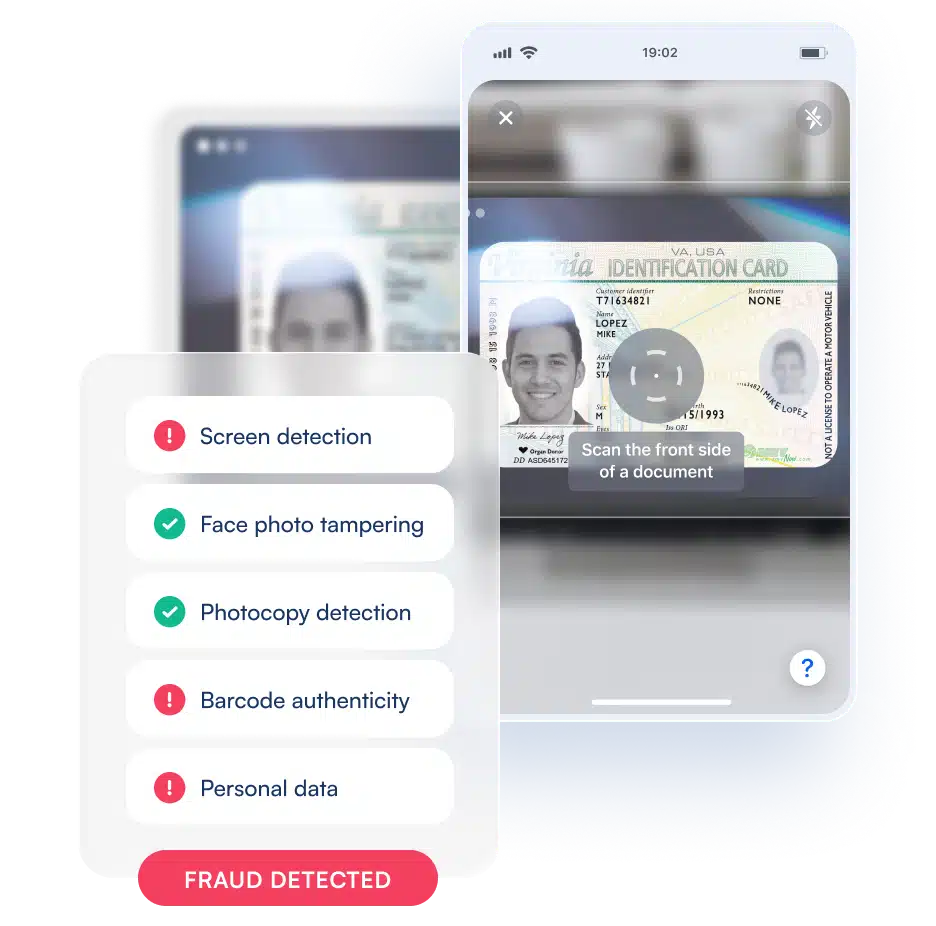
This is where integrated identity platforms become critical. By combining document verification, biometric analysis, and real-time risk scoring into a single workflow, platforms like Microblink enable agentic payments to operate safely at scale.
Instead of slowing users down, identity verification becomes a dynamic input that agents can reason over.
Agentic Payments and the Future of Disputes and Support
Agentic payments also reshape customer support and dispute resolution. Autonomous agents can:
- Initiate chargebacks when predefined conditions are met
- Escalate edge cases to human support with full context attached
- Communicate with other agents across platforms to resolve disputes faster
Instead of overwhelming support teams, agentic payments reduce noise and surface only high-value interventions.
Adoption Challenges and How to Address Them
The biggest obstacles to adopting agentic payments are not technical—they’re architectural and organizational.
Common challenges include:
- Fragmented identity systems that cannot support continuous verification
- Unclear liability ownership between platforms, banks, and agents
- Legacy onboarding workflows that were never designed for autonomy
The solution is to treat identity verification as infrastructure, not a feature. When identity, fraud, and compliance systems are unified, agentic payments become safer, faster, and easier to govern.
Agentic Payments Demand Agentic Identity
Agentic payments unlock speed, flexibility, and scale—but only when paired with modern identity verification. Autonomous agents amplify both trust and risk. Businesses that invest in continuous, adaptive identity assurance will improve onboarding, reduce fraud, and stay ahead of regulatory pressure.
Microblink’s Identity OS gives product teams the foundation they need to deploy agentic payments confidently, verifying customers, preventing synthetic identity fraud, and maintaining compliance without sacrificing conversion.