
Agentic Commerce Protocol: Secure AI Agent Identity Verification for Trust & Safety Leaders
Agentic commerce is not just e-commerce with better autocomplete. It’s a structural shift in how transactions happen. Autonomous agents initiate purchases, negotiate terms, exchange credentials, and move money without a human tapping “Buy Now.” That power is intoxicating and terrifying in equal measure.
An agentic commerce protocol exists to keep that power from becoming a liability.
For Trust and Safety leaders, the protocol is the thin line between scalable automation and reputational free fall.
What Is the Purpose of an Agentic Commerce Protocol?
At its core, an agentic commerce protocol defines how autonomous agents identify themselves, exchange trust signals, and execute transactions safely across digital commerce environments.
More specifically, it exists to:
- Establish verifiable identity and authority for AI agents acting on behalf of users or businesses
- Enforce secure transaction rules without manual oversight
- Provide auditability for regulators, internal risk teams, and post-incident forensics
- Prevent spoofed agents, synthetic identities, and unauthorized delegation
Without a protocol layer, agentic commerce devolves into credential sharing, brittle APIs, and blind trust. That’s not commerce. That’s a breach waiting to happen.
Why Security and Compliance Are Non-Negotiable in Agentic Commerce
Traditional fraud models assume a human at the keyboard. Agentic systems break that assumption entirely.
New risks Trust and Safety teams face:
- Spoofed agents pretending to represent legitimate customers or merchants
- Synthetic identities embedded into autonomous workflows at scale
- Unchecked delegation, where agents exceed the authority they were granted
- Regulatory exposure, since KYC/AML obligations do not disappear just because an agent acted instead of a person
An agentic commerce protocol must treat identity verification, authorization, and transaction integrity as a single system, not disconnected controls.
Key Features of a Secure Agentic Commerce Protocol
1. Verifiable Agent Identity Mapping
Every agent must be cryptographically and logically bound to:
- A real, verified human or legal entity
- A clearly scoped set of permissions
- A revocable trust relationship
This prevents ghost agents, impersonation, and shadow automation.
2. Secure Delegation of Authority
Protocols must define:
- What an agent can do
- Under what conditions
- For how long
Delegation without limits is how automation turns into fraud.
3. Built-In Compliance Enforcement
KYC and AML checks must be:
- Triggered dynamically based on transaction risk
- Applied consistently across agent-initiated flows
- Logged and auditable
Compliance cannot be bolted on after the fact.
4. Interoperability Across Agent Systems
Agentic commerce only works if agents can interact across platforms. This is why standardization matters.
Common protocol approaches include:
- ACP (Agentic Commerce Protocol)
- MCP (Model Context Protocol)
- A2A (Agent-to-Agent)
- AP2 (Agent-to-Platform)
Interoperability ensures agents can transact without bypassing security controls.
The Identity Verification Problem Most Teams Miss
Here’s the uncomfortable truth: most identity systems were never designed for non-human actors.
Agentic systems introduce challenges like:
- Mapping agent identity to verified customer identity
- Detecting spoofed or cloned agents
- Preventing credential reuse at machine speed
- Managing false positives without breaking UX
This is where many Trust and Safety strategies quietly fail.
How Microblink Supports Secure Agentic Commerce Protocols
Microblink’s Identity Intelligence OS provides the foundation agentic commerce protocols depend on.
What this means in practice:
- Automated identity verification that works at machine speed
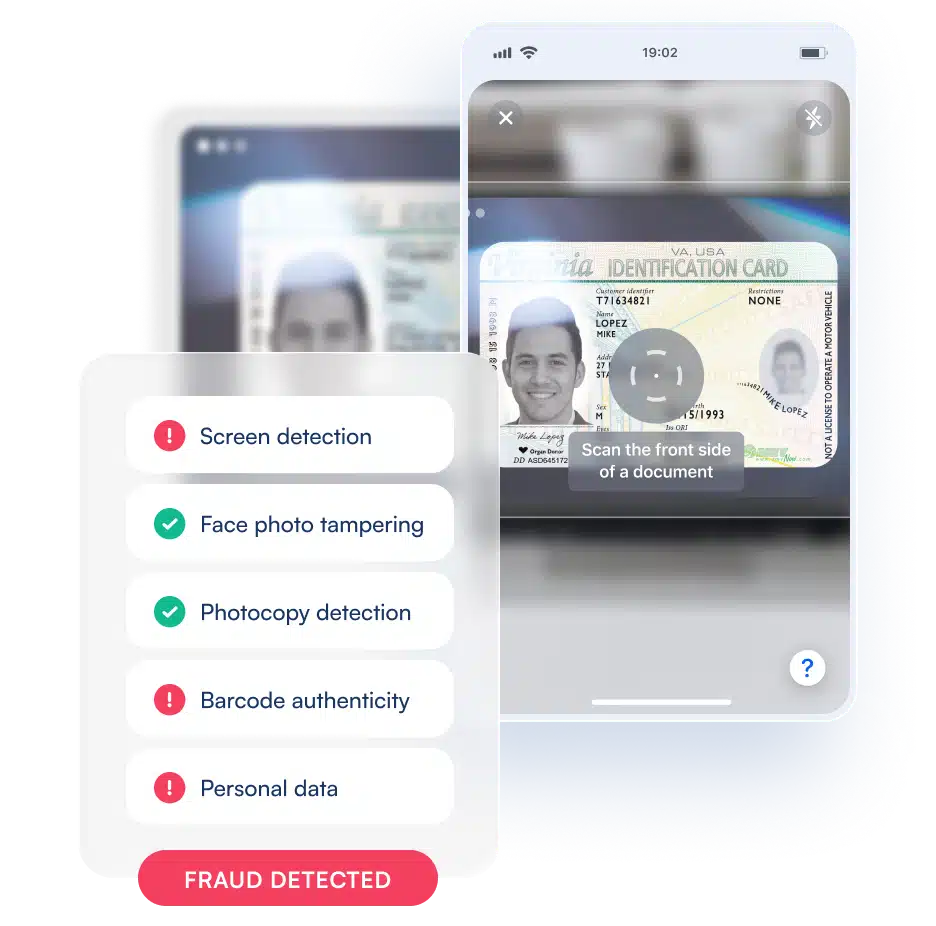
- High-accuracy document verification to stop synthetic identities before agents act
- Low false-positive rates, preserving seamless onboarding experiences
- Audit-ready identity workflows aligned with KYC/AML requirements
By anchoring autonomous agents to verified, real-world identities, Microblink helps ensure agentic commerce scales without eroding trust, compliance, or platform integrity.