
Payment Fraud API: Stop Synthetic Identity Fraud Before It Costs You

Payment fraud is no longer confined to stolen cards and simple rule evasion. Today’s attacks blend synthetic identities, automated tooling, and AI-driven manipulation that can bypass legacy controls while triggering costly false declines. For risk leaders, the challenge is implementing a payment fraud API that blocks real fraud in real time without slowing transactions, alienating customers, or creating compliance gaps.
A modern payment fraud prevention API must do more than score transactions. It must understand who is behind the payment, adapt to evolving fraud tactics, and integrate seamlessly into existing payment processing infrastructure.
What Is a Payment Fraud API?
A payment fraud API is a software interface designed to detect, prevent, and respond to fraudulent payment activity as transactions occur. It evaluates transaction data, identity signals, and behavioral patterns to determine whether a payment should be approved, challenged, or blocked.
While most teams understand payment fraud APIs as transaction-level controls, advanced solutions extend deeper into identity verification. By linking payments to verified identities and device behavior, these APIs reduce reliance on blunt rules that often drive false positives.
Why Traditional Payment Fraud Detection Falls Short
Many existing fraud systems rely heavily on static rules or historical transaction patterns. While effective against known threats, these approaches struggle with synthetic identity fraud, mule accounts, and AI-assisted attacks that look legitimate on the surface.
This often leads to an uncomfortable tradeoff. Tighten controls, and false declines spike. Loosen them, and fraud losses increase. A modern payment processing API with fraud detection must break this tradeoff by continuously adapting risk decisions in real time.
Core Capabilities of a Modern Payment Fraud Prevention API
To meet today’s threat landscape, payment fraud APIs must combine speed, accuracy, and adaptability. The most effective platforms operate as real-time decision engines rather than post-transaction reporting tools.
| Capability | Why It Matters |
|---|---|
| Real-Time Decisioning | Stops fraud before authorization, not after settlement |
| Identity-Linked Risk Signals | Detects synthetic and stolen identities behind transactions |
| Adaptive Risk Scoring | Adjusts decisions dynamically as behavior changes |
| Low-Latency Performance | Maintains fast payment flows under peak load |
| Explainable Outcomes | Supports audits, disputes, and regulatory reviews |
These capabilities allow fraud teams to move beyond binary approve/decline logic and adopt risk-aware decisioning that reflects real-world complexity.
Preventing Synthetic Identity Fraud at the Payment Layer
Synthetic identity fraud increasingly targets payment systems because traditional transaction checks lack identity context. Fraudsters combine fabricated identities with legitimate credentials to build trust before executing high-value fraud.
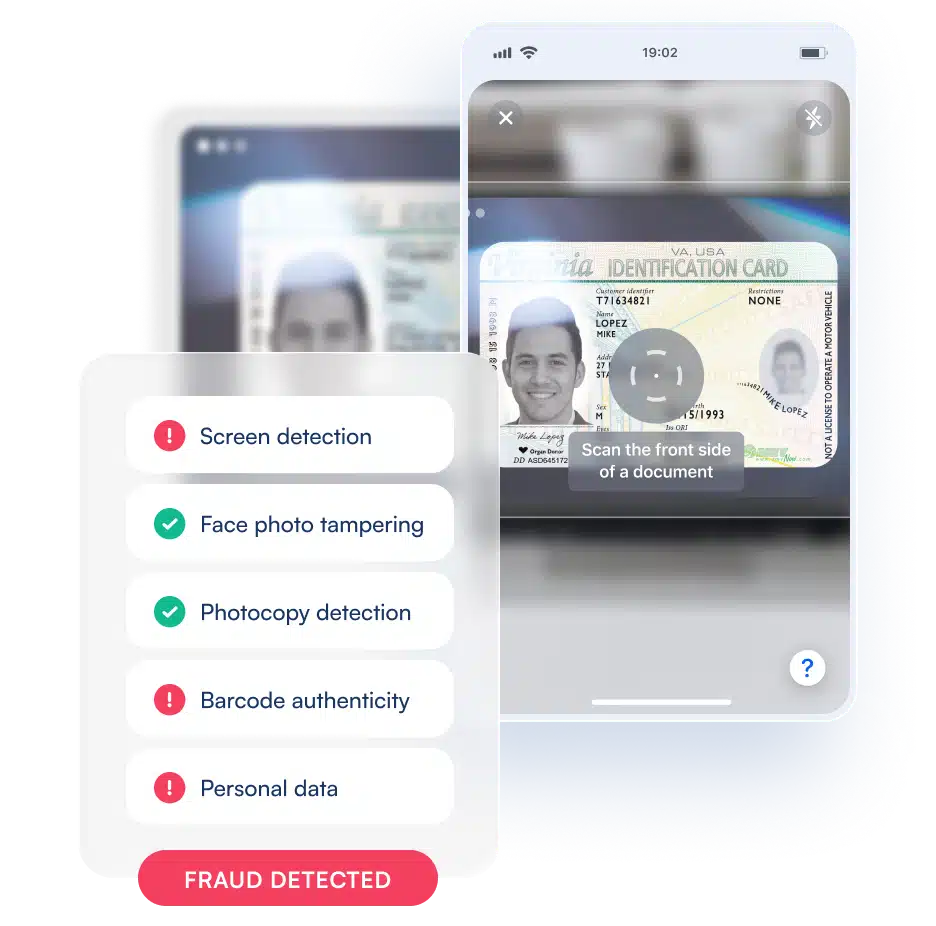
A payment fraud API that integrates identity verification can detect these patterns early. By validating government-issued IDs, matching biometrics, and correlating device and behavioral signals, the API identifies identities that look valid individually but fail when evaluated holistically.
Balancing Fraud Prevention With Customer Experience
False declines are one of the most expensive forms of fraud prevention failure. Each unnecessary rejection erodes trust, drives churn, and pushes customers toward competitors.
Modern payment fraud prevention APIs reduce false positives by applying adaptive authentication. Low-risk transactions proceed frictionlessly, while high-risk activity triggers step-up checks only when needed. This risk-based approach preserves conversion while maintaining strong fraud controls.
Integrating a Payment Fraud API Into Existing Systems
For risk and engineering teams, integration complexity is a critical factor. A well-designed payment fraud API should slot into existing authorization flows without disrupting payment processors, gateways, or orchestration layers.
REST-based APIs, clear authentication mechanisms, and predictable response codes allow teams to integrate fraud detection without rearchitecting payment systems. Many organizations deploy fraud APIs in parallel with existing tools, gradually shifting decision authority as confidence grows.
Data Privacy, Security, and Compliance Considerations
Payment fraud APIs handle highly sensitive data, making security and compliance non-negotiable. Leading platforms use end-to-end encryption, tokenization, and strict access controls to protect data in transit and at rest.
Support for GDPR, PCI-DSS alignment, and audit-ready logging ensures that fraud prevention strengthens compliance rather than introducing new regulatory risks. For global organizations, regional data handling and configurable retention policies are essential.
Operational Impact and ROI of Payment Fraud APIs
Beyond fraud loss reduction, payment fraud APIs deliver measurable operational benefits. Automating risk decisions reduces manual review volume, allowing fraud teams to focus on high-value investigations instead of routine approvals.
Organizations typically see reduced chargebacks, lower dispute costs, and improved authorization rates. Over time, better signal quality leads to more accurate models and lower infrastructure overhead, improving ROI across fraud, compliance, and customer experience teams.
Performance Monitoring and Optimization Best Practices
Because fraud detection sits directly in the payment path, performance monitoring is essential. Best-in-class teams track API latency, error rates, and decision outcomes in real time to prevent bottlenecks.
Health checks, fallback logic, and alerting help ensure resilience during traffic spikes or upstream failures. Continuous monitoring also enables rapid tuning of risk thresholds as fraud patterns evolve.
How Microblink Approaches Payment Fraud Detection Differently
Microblink’s platform extends payment fraud APIs beyond transaction scoring by embedding identity intelligence directly into fraud decisioning. By combining document ID verification, biometrics, and advanced fraud signals, Microblink helps organizations stop fraud at the identity level before it becomes a payment loss.
With fast performance, high verification accuracy, and cost-effective scalability, Microblink enables businesses to meet KYC and AML requirements while reducing false declines and protecting customer trust. This identity-first approach gives risk teams the control and confidence needed to defend modern payment ecosystems.
Selecting a payment fraud API is a strategic decision that affects revenue, compliance, and customer loyalty. The most effective solutions combine real-time decisioning, adaptive risk management, seamless integration, and identity-driven intelligence. To learn more about how Microblink can help, get in touch today.