
Crypto KYC Requirements Explained

Cryptocurrency adoption has skyrocketed over the past decade, and so has regulatory scrutiny. Governments and watchdogs around the world are pushing for stronger oversight of digital asset markets, and the first line of defense is often KYC, or Know Your customer.
KYC in crypto is its own unique practice and differs from KYC in traditional finance. For compliance leaders in the crypto industry, it’s crucial to balance regulatory requirements with fast, frictionless onboarding that doesn’t drive customers away
In this blog, we’ll explore the meaning of KYC in crypto, the challenges compliance professionals face, and the best practices for building scalable, efficient, and regulator-ready systems.
Why KYC Matters in the Crypto Industry
KYC is more than simply a regulatory box to tick. For crypto exchanges, wallet providers, and DeFi platforms, it’s a legal requirement and a strategic safeguard.
The purpose of KYC in crypto:
- Preventing money laundering and terrorist financing by verifying the identity of every user.
- Mitigating sanctions risk by screening customers against watchlists.
- Detecting fraud — particularly synthetic identities that combine real and fake data.
- Building trust with regulators, banking partners, and end users.
Crypto introduces new risks compared to traditional finance. Fraudsters exploit mixers, privacy coins, and anonymous wallet structures to obscure transactions. Without robust KYC controls, exchanges can become unwitting channels for illicit activity.
And failure to implement proper compliance and fraud controls in place can mean costly regulatory actions and bad press. For example, one estimate states that in 2024 the total value of fines imposed for crypto regulatory breaches globally reached $5.1 billion, a 39% rise from 2023.
What Is KYC in Crypto? Defining the Process
At its core, KYC in crypto is simple: it is the process of verifying the identity of users before allowing them to trade, hold, or transfer digital assets. But the details matter.
Documents typically required for crypto KYC
- Government-issued photo ID (passport, driver’s license, national ID card)
- Proof of address (utility bill, bank statement)
- Selfie or biometric verification for liveness
- For enhanced due diligence (EDD): proof of income, source of funds, business documentation
Verification levels
Most crypto platforms use a multi-tiered KYC system:
- Basic verification: email and phone, often tied to small transaction limits.
- Intermediate verification: ID upload + selfie, unlocking higher limits.
- Enhanced due diligence (EDD): required for high-value transactions, includes source-of-funds checks and deeper screening.
FATF Travel Rule and DeFi
The FATF Travel Rule requires exchanges to share customer information when transferring assets above certain thresholds. For decentralized finance (DeFi), applying KYC is more complex, but regulators are increasingly insisting on it.
How the KYC Process Works for Crypto Exchanges
A typical crypto KYC workflow looks like this:
- User onboarding: User creates an account, submits ID documents, and provides basic information.
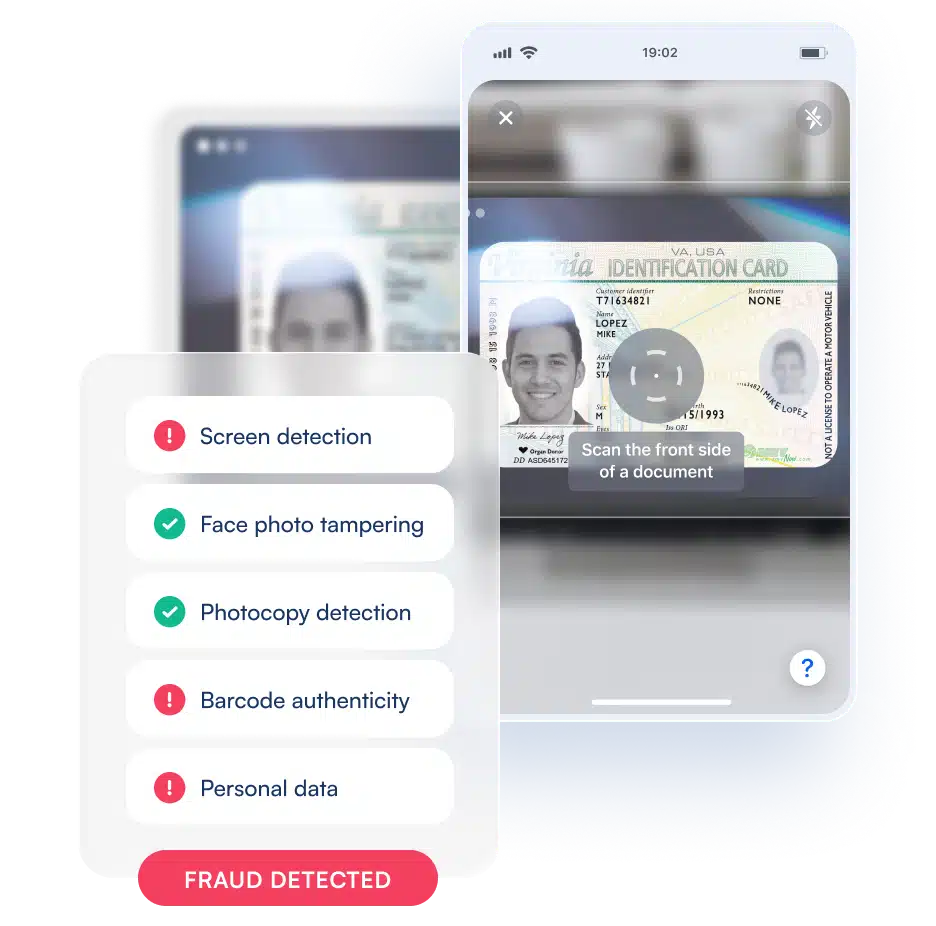
- Document verification: AI-driven OCR extracts data, validates authenticity, and checks against tampering.
- Biometric check: User provides a selfie or liveness scan to confirm they match the ID.
- Watchlist screening: Customer details are screened against sanctions, PEP (Politically Exposed Person), and adverse media lists.
- Ongoing monitoring: Transactions are monitored for suspicious activity, such as large transfers to mixers or multiple wallets.
Each of these steps protects against fraud while demonstrating compliance with AML and KYC regulations.
Challenges in Implementing Crypto KYC
Compliance leaders face a difficult balancing act when it comes to KYC in crypto. Regulations differ significantly across jurisdictions, with the U.S., EU, and APAC each imposing their own requirements, creating a patchwork of obligations that can be hard to navigate.
At the same time, many organizations still rely on manual identity verification processes, which slow down onboarding, frustrate customers, and create operational bottlenecks. Fraudsters exploit these weaknesses, often using synthetic identities that can slip past legacy verification tools.
Adding to the challenge is the tension between friction and speed: if onboarding is too slow or cumbersome, customers may abandon the process altogether and turn to competitors with lighter checks. The result is that compliance teams often spend their time firefighting issues rather than scaling efficient, long-term solutions.
Best Practices for Effective Crypto KYC
To overcome these challenges, forward-looking compliance leaders are turning to technology and smarter processes. Automating document checks with AI and optical character recognition (OCR) reduces the need for manual review, speeding up verification while improving accuracy.
Adding biometric verification and liveness detection prevents fraudsters from using stolen or doctored IDs. A risk-based tiering approach ensures that enhanced due diligence is applied only where necessary, striking a balance between compliance and customer convenience. Integrating watchlist screening directly into onboarding flows strengthens sanctions and PEP compliance without slowing users down.
The Impact of KYC on User Experience and Trust
For crypto businesses, onboarding is often a make-or-break moment. A clunky or overly burdensome KYC flow can lead to user drop-off, while a seamless and transparent process builds long-term trust. Transparent KYC processes not only meet those expectations but also help build credibility with both retail and institutional clients. This credibility translates directly into higher lifetime value, as customers are more likely to stay loyal to platforms where they feel both secure and respected.
Optimizing conversion rates during KYC is critical. Progressive verification can help reduce abandonment by allowing users to unlock higher transaction limits gradually, rather than demanding all documents upfront. Mobile optimization ensures that the process runs smoothly on smartphones, which are the primary devices for most crypto users. Clear communication about why certain documents are required also reduces frustration and increases completion rates.
Selecting the Right KYC Provider for Crypto Businesses
Considering the many negative consequences of non-compliance – which include regulatory fines, loss of customers, reputational damage and even revocation of license – it is imperative for crypto exchanges to work with a KYC provider that will enable them to accurately and quickly verify identities while flagging fraud.
Not all KYC providers are built for the complexities of crypto. When evaluating vendors, there are several key factors to consider.
Selecting the Right KYC Provider for Crypto Businesses
| Evaluation Criteria | What to Look For |
| Accuracy | Ability to detect sophisticated fraud, including synthetic IDs. |
| Automation | Minimizes manual review to improve speed and reduce costs. |
| Global Coverage | Handles documents and regulations across multiple jurisdictions. |
| Integration | Seamlessly plugs into existing systems and workflows. |
| Scalability | Supports rapid growth without hindering compliance processes. |
Common Pitfalls in KYC Implementation
- Incomplete data capture.
- Overly complex document requirements leading to user abandonment.
- Regulatory blind spots in cross-border operations.
Handling False Positives and Disputes
Ensure your provider supports:
- Appeal workflows.
- Manual review escalation.
- Customer-friendly communication when legitimate users are flagged.
How Microblink Supports KYC in Crypto
Microblink offers a comprehensive KYC platform designed to meet the challenges of crypto compliance head-on.
Features of Microblink KYC for crypto include:
– Global ID Coverage: Instantly verifies government-issued IDs
– Fraud Prevention: Matches credit/debit cards to users for fiat onramps, P2P platforms, and staking payouts
– Image Capture: Delivers high-quality images in any real-world scenario
– Cross-platform: iOS, Android, and Web support
– Lightweight Architecture: Won’t slow down your DApp or custodial app performance
By reducing manual reviews and improving accuracy, Microblink helps compliance teams save time, cut operational costs, and stay ahead of fraudsters — all while delivering a smooth onboarding experience.
Conclusion: Building a Scalable, Compliant Future for Crypto
The crypto industry is under the microscope, and regulators expect more than lip service. KYC in crypto is the foundation of compliance, risk mitigation, and long-term trust.
For compliance leaders, the challenge is to enforce rigorous checks without slowing growth. With the right processes and technology, it’s possible to achieve both.
In the fast-moving world of digital assets, compliance isn’t just about avoiding penalties, it’s about gaining a competitive edge. If you’d like to learn more about Microblink for Crypto, get in touch today.