
Best Agentic Fraud Capture Software & AI Compliance Tools

As financial crime evolves from manual scams to sophisticated, AI-driven attacks, businesses require equally advanced defenses. Static, rule-based systems are no longer enough to stop modern fraudsters who use generative AI and automated bots to bypass traditional security perimeters.
Agentic fraud capture software and AI-powered compliance platforms represent the next frontier in digital security. Unlike passive monitoring tools, these solutions utilize autonomous agents and machine learning to move beyond simple “if-then” logic. They detect anomalies in real-time, verify identities with forensic precision, and secure customer journeys autonomously—all without compromising the user experience.
In this guide, we’ve analyzed the top fraud prevention solutions leading the charge in agentic AI compliance to help you secure your ecosystem and maintain regulatory integrity.
Quick Comparison: Top Agentic Fraud & Compliance Tools
| Product | Compliance Features | Industry Focus | AI Capabilities | User Experience | Developer Experience |
|---|---|---|---|---|---|
| Microblink | – Focus on document capture and verification- Not a standalone AML system- Privacy-centric approach with on-device processing | Digital Onboarding & ID Verification | Edge-based computer vision- High accuracy in data extraction across global ID types | – Superior user experience with real-time feedback- Privacy-first, reducing data transmission risks | – Requires developer resources for SDK integration- Not a plug-and-play solution for non-technical users |
| Spec | – Customer journey security- Automated, invisible defense- No-code deployment for rapid adaptation | Marketplaces & Enterprise eCommerce | Behavioral and journey analysis- Captures 14x more data than traditional tools | – Invisible to fraudsters- No manual intervention needed for threat mitigation | – No-code deployment- Requires shift to journey-centric thinking |
| ComplyAdvantage | – AML compliance with fraud detection- Dynamic thresholds- Identity clustering | Banks & Fintechs | Graph network detection- Excellent visualization of complex fraud networks | – Unified platform for fraud and AML- Explainable AI to understand alerts | – Complex for small teams- Requires ongoing tuning to manage false positives |
| Sardine | – Real-time ACH fraud detection- Crypto on-ramp protection- Allows instant settlement | Crypto & Instant Payments | Device fingerprinting and behavior- High-fidelity behavioral biometrics | – Industry-leading detection- Allows instant liquidity for fintechs | – Requires deep technical integration- Primarily focused on financial services |
| BioCatch | – Behavioral biometrics- Social engineering detection- Mule account detection | Account Takeover Prevention | Input behavior analysis- Tracks over 2,000 behavioral parameters | – Passive authentication- Adds no friction to user experience | – Requires embedding code into apps- Needs a user interface to capture data |
1. Microblink

Platform Summary
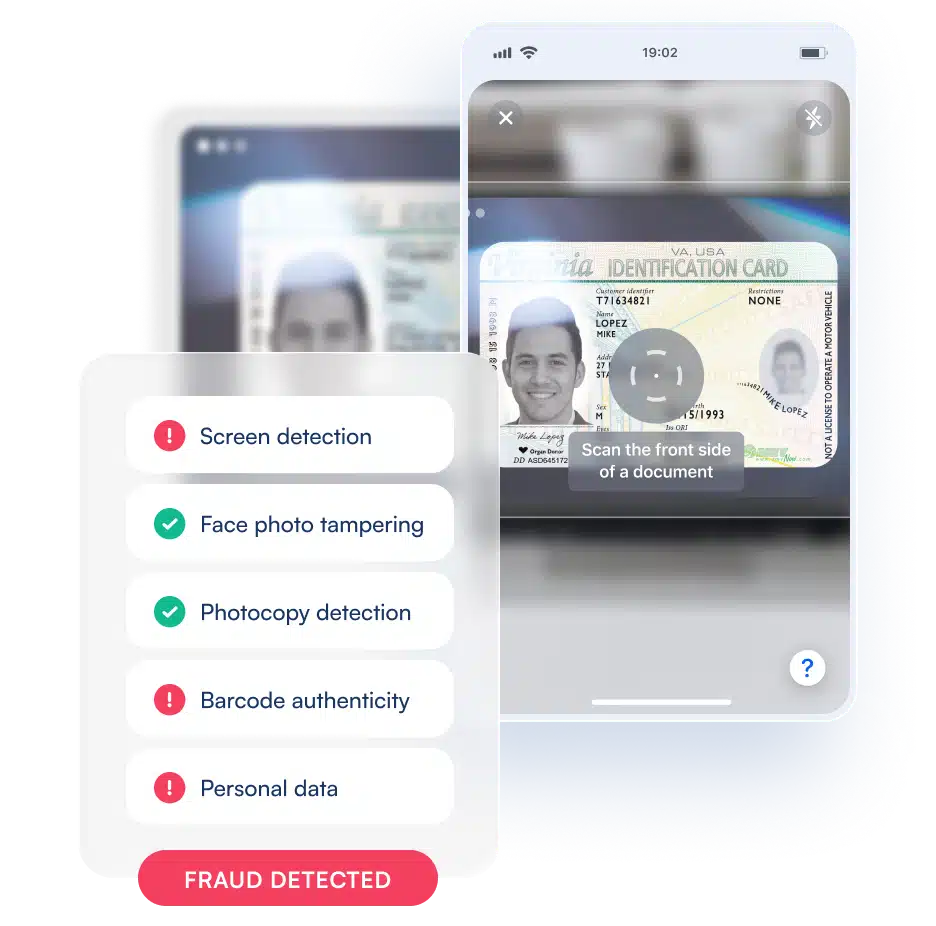
Microblink delivers enterprise-grade agentic fraud capture software, safeguarding institutions against sophisticated fintech fraud prevention challenges with next-generation AI. Rooted in over a decade of computer vision R&D, Microblink provides real-time identity verification software and document authentication to proactively stop threats like synthetic identity fraud, account takeover, and deepfake attacks at the earliest point of interaction. Microblink’s proprietary machine learning models, developed in-house, empower global organizations to reduce financial losses, streamline compliance, and cut operational costs associated with manual reviews.
Key Benefits
- Proprietary AI & In-House Machine Learning: Complete control over algorithms, rapidly adapting to new fraud patterns like deepfakes and synthetic identities.
- Advanced Computer Vision & On-Device Processing: Real-time, privacy-first verification with data processed directly on the user’s device.
- Multi-Layered Verification: Combines document analytics, biometric face matching, and liveness detection for comprehensive defense.
- Scalable, SDK-First Architecture: Built for high-volume, global operations with robust SDKs and a document fraud detection API for seamless integration.
Core Features
- Edge-Based AI Processing: Processes sensitive identity data on-device, minimizing latency and attack surface.
- Active User Guidance: Real-time feedback ensures high-quality, glare-free document captures, rivaling the best ID scanning app experiences.
- Document Liveness Detection: Detects spoofing attempts using advanced neural networks.
- Customizable Workflows: Configure risk thresholds and decision logic to align with your institution’s needs.
Primary Use Cases
- Secure Customer Onboarding: Instantly verifies identity documents and liveness during registration, preventing fraudulent account creation.
- Real-Time Payment Fraud Mitigation: Integrates ID verification into payment workflows to combat CNP fraud and chargebacks.
- Accelerated KYC/AML Compliance: Automates data extraction and screening against global watchlists for audit-ready compliance.
Recent Updates
- Expanded global document coverage to over 2,500 ID types.
- Enhanced neural networks to counter sophisticated AI-generated screen-replay attacks.
- Rebranding of BlinkReceipt to Actual, reflecting product evolution.
Limitations
- Specialization in Capture: Best-in-class for onboarding and verification, but requires integration with third-party systems for ongoing transaction monitoring.
- Developer Integration Required: SDK-first approach necessitates technical resources for implementation.
- Hardware Performance: Effectiveness can be influenced by the quality of the end-user’s camera hardware.
2. Spec

Platform Summary
Spec provides a Customer Journey Security platform that utilizes agentic AI to monitor the entire user lifecycle, from the moment a visitor lands on a site to the final transaction. By analyzing the full journey rather than isolated events, Spec identifies patterns of automated fraud and bot activity that traditional transaction-based tools often miss. The platform’s invisible defense prevents fraudsters from understanding or reverse-engineering security triggers, effectively functioning as advanced CNP fraud detection software that maintains a frictionless user experience while blocking sophisticated, multi-stage attacks in real-time.
Core Features
- Journey-Time Orchestration: Captures up to 14x more data points by tracking every interaction in a session.
- Invisible Defense Layer: Security measures operate silently, making it impossible for bad actors to see what triggered a block.
- Automated Mitigation: Deploys countermeasures like honeypots or challenges autonomously when high-risk behavior is detected.
- No-Code Deployment: Risk teams can deploy and adjust fraud defense strategies instantly without developer intervention.
Primary Use Cases
- Bot Mitigation for Ticketing: Blocks scalper bots to ensure tickets reach real customers.
- Marketplace Fraud Prevention: Detects fraudulent listings and account takeovers by analyzing behavioral anomalies.
- Enterprise eCommerce Security: Prevents promo abuse and card testing by tracking user journeys across sessions.
Recent Updates
- Launched an upgraded Customer Journey Security Platform with a no-code interface for rapid deployment.
- Enhanced automated mitigation features for real-time threat response.
- Improved data governance tools for privacy compliance.
Limitations
- Paradigm Shift: Requires risk teams to adopt journey-centric thinking, which may involve a learning curve.
- Data Governance: High volume of interaction data per session necessitates robust privacy policies.
- Enterprise Focus: Feature set and pricing are tailored for mid-market and enterprise clients.
3. ComplyAdvantage

Platform Summary
ComplyAdvantage offers a comprehensive financial crime risk intelligence platform that bridges the gap between fraud detection and banking AML software. Using a proprietary graph network and a massive global database, the platform uncovers hidden connections between entities to identify organized crime and money laundering rings. ComplyAdvantage provides a unified view of risk, combining real-time transaction monitoring with deep identity screening to help financial institutions stay compliant and proactively identify evolving fraud tactics.
Core Features
- Graph Network Detection: Visualizes complex connections between accounts and entities to spot money muling and fraud networks.
- Dynamic Thresholds: Uses machine learning to adjust risk rules based on historical data, reducing false positives.
- Identity Clustering: Groups disparate accounts with shared characteristics to detect synthetic identities.
- Unified Case Management: Integrates customer screening, transaction monitoring, and investigations in a single dashboard.
Primary Use Cases
- AML Compliance for Fintechs: Screens customers against global sanctions and PEP lists during onboarding.
- Real-Time Payment Screening: Monitors transactions against adverse media and watchlists to prevent illicit fund processing.
- Adverse Media Monitoring: Tracks negative news related to clients for early warning of reputational or legal risks.
Recent Updates
- Integrated the ‘Mesh’ overlay to unify customer screening, transaction monitoring, and case management.
- Enhanced explainable AI for greater transparency in alerting.
- Expanded global data sources for improved risk intelligence.
Limitations
- System Complexity: Requires dedicated compliance professionals to manage graph analytics and configuration.
- Tuning Requirements: Ongoing tuning needed to align with organizational risk appetite and minimize false alerts.
- Cost of Entry: Enterprise-grade platform may be cost-prohibitive for early-stage startups.
4. Sardine

Platform Summary
Sardine is a fraud prevention and compliance platform built for the high-velocity world of fintech, crypto, and instant payments. It focuses on the critical window of real-time settlement, using device intelligence and behavioral biometrics to assess transaction risk in milliseconds. Sardine’s unique ability to underwrite risk for instant ACH transfers allows fintechs to provide immediate liquidity to users while distinguishing between genuine customers and fraudsters using stolen credentials or social engineering tactics.
Core Features
- Device & Behavior Fingerprinting: Analyzes thousands of signals, including device handling and typing cadence, to detect bots or remote access tools.
- Real-Time ACH Fraud Detection: Predicts the likelihood of fraudulent or insufficient funds before settlement, enabling instant funding.
- Crypto On-Ramp Protection: Detects identity theft and stolen credit cards in crypto transactions.
- Social Engineering Detection: Identifies if a user is being coached by a scammer during a transaction.
Primary Use Cases
- Instant Account Funding: Enables digital wallets to offer immediate trading by assessing bank transfer risk in real-time.
- Crypto Exchange Compliance: Prevents fraud during fiat-to-crypto conversions, reducing chargebacks.
- Social Engineering Prevention: Detects and blocks transactions where users are being manipulated by scammers.
Recent Updates
- Expanded integration capabilities for real-time payment rails and their payment fraud API.
- Enhanced behavioral biometrics for social engineering detection.
- Improved risk underwriting models for instant ACH transfers.
Limitations
- Sector Specificity: Highly optimized for financial services and crypto, less suitable for general eCommerce.
- Integration Depth: Requires deep integration into mobile and web application architecture.
- Regional Data Strength: Most powerful banking data models are currently strongest in North America.
5. BioCatch

Platform Summary
BioCatch is the industry leader in behavioral biometrics, focusing on the psychological and physical interactions between users and their devices. By monitoring over 2,000 behavioral parameters—such as mouse movements, swipe patterns, and typing rhythm—BioCatch creates a unique digital profile for every user. This technology is especially effective at stopping fraud that traditional data-centric tools miss, complementing standard customer identity verification software by detecting social engineering and authorized push payment (APP) scams.
Core Features
- Behavioral Biometrics: Tracks subtle physical cues that are nearly impossible for fraudsters or bots to replicate.
- Social Engineering Detection: Identifies behavioral anomalies suggesting a user is acting under duress or being coached.
- Mule Account Detection: Analyzes account operation patterns to spot money laundering activity.
- Remote Access Tool (RAT) Detection: Detects when a user’s machine is being controlled externally.
Primary Use Cases
- Preventing Account Takeovers: Detects sessions where behavior does not match the established user profile, even if credentials are correct.
- Stopping Remote Access Scams: Identifies when a user’s machine is being controlled by a scammer.
- Securing High-Value Transfers: Adds passive authentication for large wire transfers without adding friction.
Recent Updates
- Introduced advanced ‘Mule Account Detection’ using collective intelligence across its banking network.
- Enhanced detection of social engineering and coaching scams.
- Improved integration with major banking platforms.
Limitations
- Narrow Scope: Specialized behavioral tool, typically used as part of a larger fraud stack.
- UI Dependency: Requires a user interface (web or mobile) to capture behavioral data.
- Tuning for Social Engineering: Requires careful tuning to avoid flagging legitimate but unusual behavior.
Looking to strengthen your compliance stack further? Explore our guide to top KYC solution providers or learn how AI-powered onboarding can accelerate secure customer acquisition.
For tailored recommendations or to see Microblink in action, contact our team for a personalized demo.
Frequently Asked Questions
What is Agentic Fraud Capture Software?
Agentic Fraud Capture Software represents the next evolution in digital security, moving beyond traditional rule-based systems and passive machine learning models. This technology employs sophisticated AI “agents”—autonomous programs designed to proactively hunt, investigate, and neutralize fraudulent activities in real-time. Unlike older systems that simply flag transactions based on pre-set criteria, agentic AI mimics the investigative process of a human analyst. It independently gathers data from multiple sources, analyzes complex behavioral patterns, and makes intelligent decisions to block emerging threats before they can cause financial or reputational damage. These agents can adapt their strategies on the fly, learning from every interaction to become more effective at identifying novel fraud typologies.
Why is it Important?
In today’s high-volume digital economy, the speed and complexity of fraud attacks have overwhelmed human-led prevention teams. Agentic Fraud Capture Software is critical because it operates at machine speed and scale, 24/7. This autonomous capability drastically reduces the “dwell time” of fraudulent actors within your system, minimizing potential losses. By automating the detection and initial response process, it frees up your expert fraud analysts to focus on high-level strategic investigations rather than being bogged down by an overwhelming number of false positives. This leads to superior accuracy, improved operational efficiency, and a more robust, scalable defense posture that can adapt to the constantly shifting tactics of sophisticated fraudsters.
How to Choose the Best Software Provider
Selecting the right agentic fraud software provider requires a focus on technological sophistication and business alignment. First, evaluate the core AI and machine learning models. Ask about the agent’s level of autonomy, its ability to learn from new data (reinforcement learning), and the transparency of its decision-making process—”explainable AI” is crucial for compliance and review. Second, assess integration capabilities. The best solutions offer robust APIs that seamlessly connect with your existing tech stack, including payment gateways, CRMs, and user authentication systems. Finally, consider the provider’s domain expertise and support. Look for a partner with a proven track record in your industry, a clear roadmap for future development, and a dedicated support team that can help you customize rules and optimize the performance of the AI agents for your specific risk landscape.
What is agentic fraud capture software and how does it differ from traditional fraud detection tools?
Agentic fraud capture software leverages autonomous agents and advanced AI, such as machine learning and behavioral analytics, to detect and respond to fraud in real-time. Unlike traditional rule-based systems that rely on static “if-then” logic, agentic solutions adapt dynamically to new threats, analyze complex user behaviors, and operate autonomously to mitigate risks without manual intervention. This makes them especially effective against sophisticated, AI-driven attacks and evolving fraud tactics that can bypass legacy systems.
How do agentic fraud and compliance tools improve the customer experience while enhancing security?
Agentic fraud and compliance tools are designed to minimize friction for legitimate users by performing passive, real-time analysis and verification. Features like on-device processing, behavioral biometrics, and invisible security layers ensure that most users experience seamless onboarding and transactions. These systems only intervene or escalate when genuine anomalies are detected, reducing false positives and manual reviews while maintaining a high level of security.
What are the main considerations when integrating agentic fraud capture solutions into existing systems?
When integrating agentic fraud capture solutions, organizations should consider technical requirements such as SDK or API integration, compatibility with existing workflows, and the need for developer resources. Data privacy and governance are also critical, especially when handling sensitive identity or behavioral data. Additionally, teams may need to adapt to new paradigms, such as journey-centric security or behavioral analytics, and ensure ongoing tuning to align with organizational risk appetite and compliance requirements.
Can agentic fraud capture software help with regulatory compliance such as KYC and AML?
Yes, many agentic fraud capture platforms offer features specifically designed to support regulatory compliance, including automated KYC (Know Your Customer) and AML (Anti-Money Laundering) checks. These tools can extract and verify identity information, screen against global watchlists, monitor transactions for suspicious activity, and provide unified case management for audits. By automating compliance processes and reducing manual intervention, they help organizations maintain regulatory integrity while improving operational efficiency.
How do agentic fraud capture tools address emerging threats like deepfakes, synthetic identities, and social engineering?
Agentic fraud capture tools use advanced AI techniques such as computer vision, behavioral biometrics, and liveness detection to identify and block emerging threats. For example, they can detect deepfake attempts through document liveness checks, spot synthetic identities by clustering related data points, and recognize social engineering by analyzing user behavior for signs of coercion or remote access. These adaptive capabilities enable organizations to stay ahead of increasingly sophisticated fraud tactics that exploit new technologies.