
As travel platforms transition toward autonomous booking and delegated workflows, securing the gap between human intent and AI action is critical for maintaining platform integrity. Our Agentic Travel Identity Control solution utilizes the “Know Your Actor” (KYA) framework to continuously authenticate both travelers and their digital agents across the entire journey, from reservation to check-in.








IDs processed every month
countries supported for verifying identities
to capture and extract data

Empower your autonomous booking agents and delegated travel workflows with Microblink’s AI-powered identity verification. Our innovative ‘Know Your Actor’ (KYA) framework ensures every AI-driven transaction is secure and compliant, verifying both human and agent identities with unprecedented precision.
Safeguard your travel platform against emerging threats like deepfake fraud and synthetic identities without compromising traveler experience. Microblink’s Decision Command Center applies dynamic risk controls and real-time verification to balance conversion with robust fraud prevention across all AI-mediated interactions.


Microblink’s KYA (Know Your Actor) framework extends identity verification beyond humans to authenticate autonomous AI booking agents and delegated travel workflows.
This ensures every transaction, whether human or AI-initiated, adheres to strict compliance and security protocols, preventing unauthorized actions and maintaining trust across your travel platform.
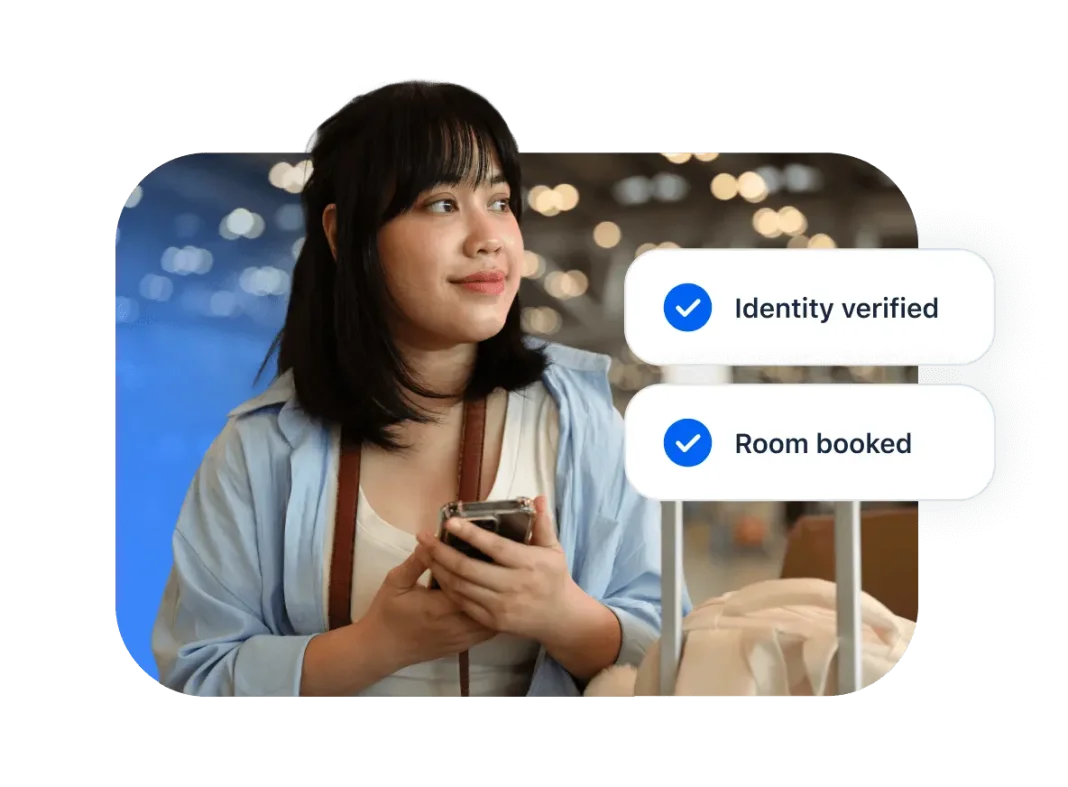
Leverage Microblink’s deepfake detection and advanced fraud signals to protect against synthetic traveler identities and sophisticated AI-driven attacks.
This proactive defense safeguards your revenue and brand reputation while ensuring legitimate travelers experience seamless, fraud-free interactions.

Microblink’s Decision Command Center enables dynamic risk orchestration, adapting verification intensity based on the travel journey stage, transaction value, and actor’s trust score.
This balances robust security with frictionless user experiences, maximizing conversion rates for bookings and changes while minimizing false declines.

First Abu Dhabi Bank partners with Microblink to accelerate ID scanning during KYC verification.

Discover how Attain is transforming the consumer-permissioned future with BlinkReceipt.

Discover how BlinkID revolutionized Jurat’s user experience and contributed to their success in the digital notary industry.

Quick and accurate ID verification, ensuring a seamless and secure registration process

Meet regulatory requirements with ID document verification and non-documentary signals


Verify identity and prevent unauthorized transactions through secure document scanning

Detect stolen or synthetic identities with precision and verify IDs to prevent fraudulent account creation and transactions

Ensure compliance and prevent underage access by instantly verifying customer ages through secure ID scanning

With 12 years of expertise in computer vision R&D, Microblink has been at the forefront of AI-driven identity verification, continuously innovating to deliver fast and accurate solutions.

We pioneered AI-driven identity verification, setting the standard for fast, secure, and accurate ID scanning solutions.

We develop our AI in-house, using proprietary data and a dedicated team of machine learning specialists to ensure unmatched accuracy and performance in identity verification.
With 12 years of expertise in computer vision R&D, Microblink has been at the forefront of AI-driven identity verification, continuously innovating to deliver fast and accurate solutions.
We pioneered AI-driven identity verification, setting the standard for fast, secure, and accurate ID scanning solutions.
We develop our AI in-house, using proprietary data and a dedicated team of machine learning specialists to ensure unmatched accuracy and performance in identity verification.
If you’re operating in travel or mobility, you’re dealing with fragmented identity checks across booking, check-in, payments, and border or regulatory requirements. Agentic travel identity control centralizes and automates these decisions through an intelligent “agent” that continuously evaluates identity, risk, and context. Instead of forcing users to repeatedly verify themselves at every step, the system carries forward a trusted identity state. This reduces friction for legitimate travelers while giving you tighter control over fraud, account sharing, and regulatory compliance across the entire journey—not just at onboarding.
Traditional identity verification is static and happens once, while single sign-on focuses on authentication convenience. Agentic identity control is dynamic and decision-driven. It continuously evaluates signals like device, behavior, location, and transaction context to determine whether to allow, step up, or block an action. For travel platforms, this means you can adapt identity requirements in real time—for example, applying stronger verification for high-risk bookings or cross-border activity without slowing down low-risk users.
It can if implemented as a rigid layer, but the goal is the opposite. Agentic systems are designed to reduce unnecessary friction by only intervening when risk signals justify it. For example, a returning traveler on a trusted device may move through booking and check-in without interruption, while a high-risk scenario triggers biometric or document verification. The challenge is tuning the decision logic correctly. If your thresholds are too aggressive or poorly calibrated, you’ll see increased drop-off and customer support complaints.
Travel platforms face unique fraud risks like account takeovers, loyalty point abuse, payment fraud, and reselling or arbitrage schemes. Agentic identity control helps by linking identity signals across sessions and transactions, making it harder for fraudsters to move undetected. It can identify anomalies such as sudden changes in booking patterns, mismatched geolocation signals, or unusual redemption behavior. Because it operates continuously, it can catch fraud not just at login or checkout, but throughout the lifecycle of the traveler.
Integration is often the biggest hurdle. Agentic identity control needs to sit as an orchestration layer that connects your identity verification provider, fraud detection systems, and booking platform. It should ingest signals from multiple sources and output real-time decisions that your application can act on. This requires robust APIs, event-driven architecture, and careful coordination between product and engineering teams. Without proper integration, you risk creating silos that limit the effectiveness of the system.
Travel platforms operate across jurisdictions, which introduces complex regulatory requirements around identity verification, data storage, and user consent. Agentic identity systems must be designed with privacy in mind, minimizing data retention and ensuring that sensitive identity information is handled securely. You also need to account for regional regulations that may require stronger identity checks or restrict how data is transferred. Compliance teams should be involved early to define policies around consent, data usage, and auditability.
While large travel platforms may have more resources to build custom solutions, mid-market companies can still benefit by leveraging vendors that offer modular, API-driven components. The key is to start with high-impact use cases, such as step-up authentication for high-risk bookings or protecting loyalty accounts. Trying to overhaul your entire identity system at once is risky and resource-intensive. A phased approach allows you to validate impact, reduce fraud, and improve user experience without overwhelming your team.