
CIP Requirements: How to Stay Compliant

Banks and financial institutions need to implement a customer identification program (CIP) as part of their obligations under the Bank Secrecy Act (BSA) and anti-money laundering (AML) regulations.
CIP, along with measures like customer due diligence (CDD), helps banks ensure their customers are who they say they are and aren’t using their accounts for fraudulent or illegal activities.
Failing to meet CIP and BSA/AML requirements can result in civil money penalties of up to $1M for institutions, along with fines and criminal sentences for individuals.
Below, we’ll explain these requirements and provide guidance on staying compliant.
The legal context of CIP requirements
As noted above, CIP is part of the patchwork of regulations and laws that govern how banks and other financial institutions do business. The Bank Secrecy Act and anti-money laundering laws help the federal functional regulator (i.e., the Federal Reserve, FDIC, SEC, etc.) ensure that banks keep consumers safe.
Other important institutions that intersect with the BSA/AML’s CIP rules include:
- The USA PATRIOT Act and CIP: The CIP went into effect with the rest of the Patriot Act in the wake of the September 11, 2001 attacks. CIP plays a role in preventing direct funding and money laundering related to terrorist groups.
- FinCEN’s role in managing CIP: The Financial Crimes Enforcement Network (FinCEN) enforces BSA/MLA regulations, including but not limited to CIP, by investigating and punishing improper reporting and recordkeeping cases.
Despite the complexity of the regulatory context surrounding the BSA/AML and related laws, their aims—and actual CIP requirements—are fairly straightforward.
Key components of CIP requirements
Three of the most important concerns outlined in 31 CFR 1020.220 include:
- Identity verification: Financial institutions must implement risk-based measures to ensure reasonable belief that customers’ identities are true.
- Record-keeping: Financial institutions must also retain detailed records of and related to customer identities for at least five years after account closure.
- Customer notice: Financial institutions must provide adequate notice to customers for any identity documentation or verification request.
These requirements amount to diligence in collecting, analyzing, processing, and storing employee identification documents.
Challenges in CIP compliance
Although the baseline CIP requirements for banks and other financial institutions are relatively straightforward, there are many challenges in maintaining them at scale.
For example, banks are faced with the ever-increasing threats of cybercrime.
Per the International Monetary Fund (IMF), threats to financial institutions have grown more ubiquitous and severe since 2016’s landmark attacks on Bangladesh’s central bank. A similar attack today could compromise global financial stability.
To keep pace, global regulations and standards are also constantly changing. For instance, Deloitte projects many new regulations to be proposed and actualized in 2024 in response to the ups and downs in the banking industry throughout 2023.
Last but not least, there are the inherent challenges of balancing security and regulatory initiatives with operational efficiency and maintaining the bottom line.
Steps to ensure CIP compliance
CIP compliance is key to a bank’s overall security and risk management strategies. Accounting for the challenges above, financial institutions should be:
- Conducting risk assessments: Banks should monitor for potentially fraudulent behavior and file suspicious activity reports when they surface.
- Training and educating personnel: Staff should be trained to process new customers’ required identity documents to ensure vigilance.
- Establishing emergency response plans: Protocols should be in place for addressing emerging issues with new and existing customers’ documents.
- Auditing for ongoing compliance: Regular assessments ensure customer identification program (CIP) systems are up-to-spec over time and at scale.
One of the best ways to cover all these best practices is to implement AI-driven technological solutions that take the guesswork out of document management.
Overcoming challenges with technology
CIP compliance exists in a crowded regulatory context highlighted by the BSA/AML, USA PATRIOT Act, and other laws FinCEN and other government agencies enforce jointly. Fortunately, the actual requirements are fairly straightforward—the main challenges to achieving and maintaining compliance are in execution.
Banks and financial institutions can automate the capture and processing necessary to verify identity by utilizing technological tools. In the best deployments, these identification platforms work hand-in-hand with cybersecurity risk management, recordkeeping, and notification infrastructure to optimize all elements of CIP.
How automation optimizes CIP compliance
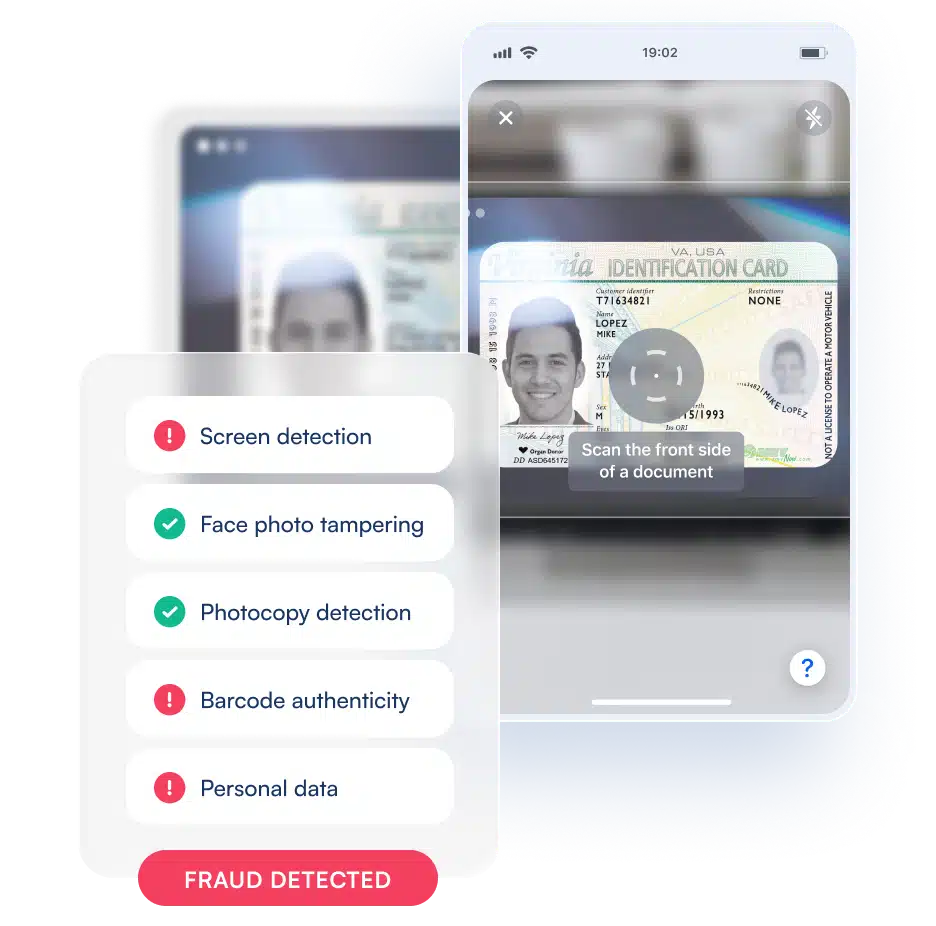
Microblink’s revolutionary BlinkID solution powers frictionless, automated capture and processing of ID documents with on-device processing in real-time—with or without an internet connection.
BlinkID helps banks and financial institutions save time and money in their CIP compliance implementations. Flexible SDKs and APIs allow the platform to interact seamlessly with your entire tech stack, maximizing user engagement.
To learn how Microblink can help you maintain CIP compliance, contact us today.